




As automotive electrical systems continue to develop, accurate battery temperature monitoring has become increasingly important for vehicle safety, charging control, and battery performance.
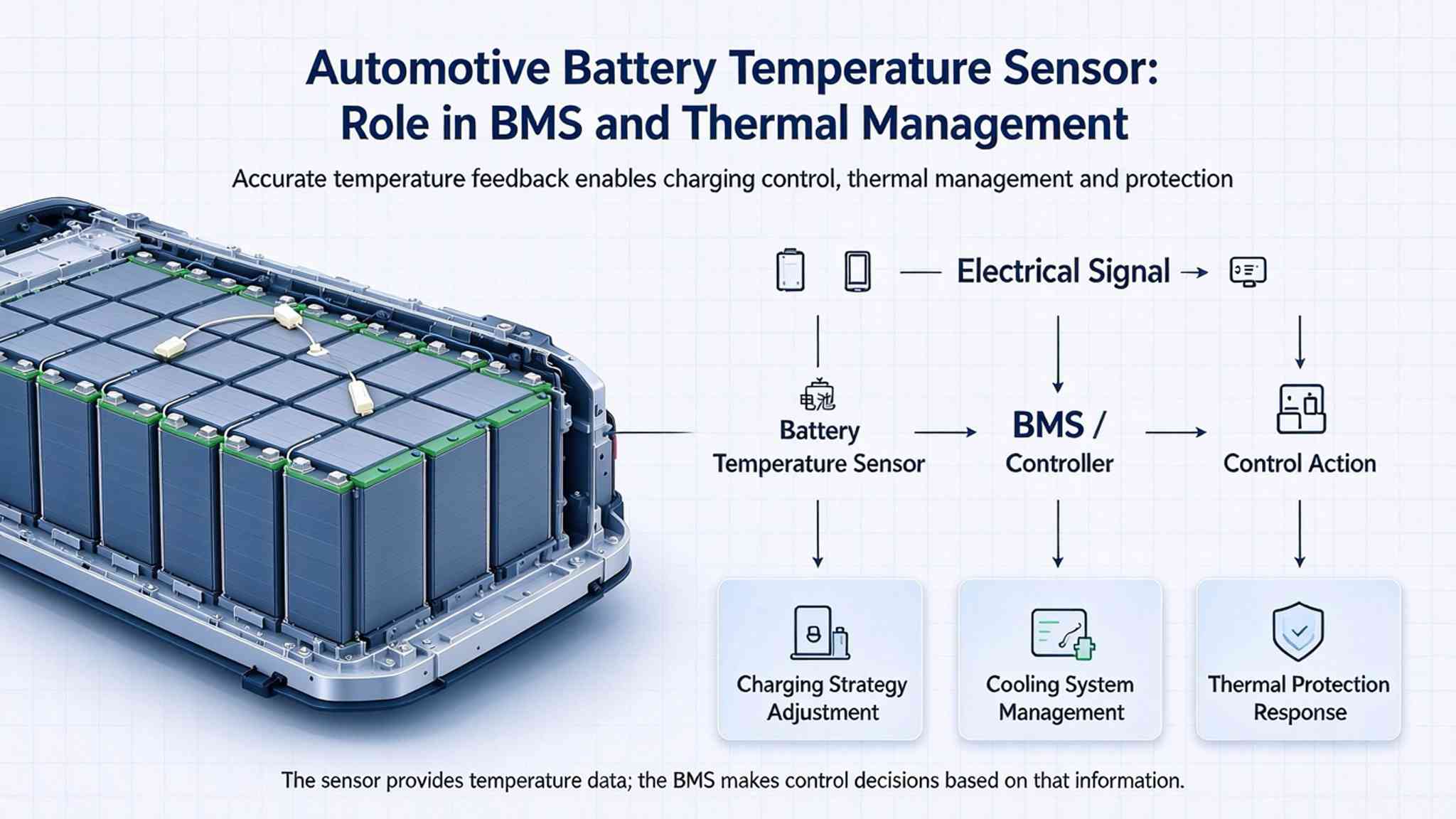
An automotive battery temperature sensor detects changes in battery temperature and converts them into an electrical signal. The signal is then processed by the relevant vehicle control system, such as a Battery Management System (BMS) or charging control module.
By providing reliable temperature feedback, the sensor can help the system adjust charging strategies, manage battery cooling, and respond to abnormal thermal conditions.
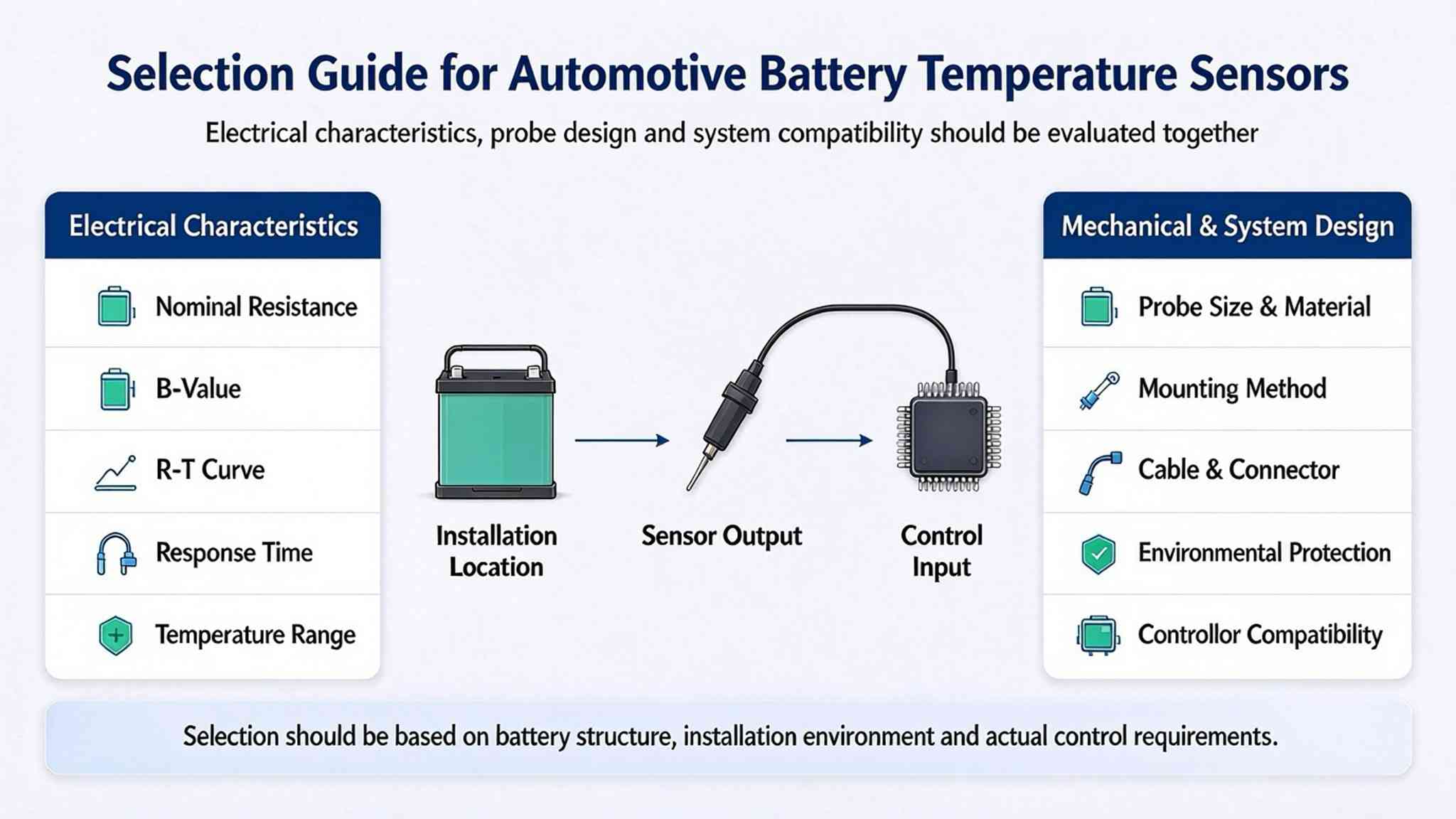
For automotive manufacturers, selecting a battery temperature sensor requires more than matching its physical size. Electrical characteristics such as NTC resistance, B-value, R-T curve, response time, and temperature range, as well as probe design, cable, connector, and controller compatibility, should all be considered.
What Is an Automotive Battery Temperature Sensor?
An automotive battery temperature sensor is designed to monitor the temperature of a vehicle battery or battery-related component.
The sensor itself does not normally control the battery directly. Instead, it provides temperature information to the control system.
A simplified process is:
Battery Temperature → Temperature Sensor → Electrical Signal → BMS / Controller → Control Action
Depending on the vehicle architecture, the temperature data can be used for battery charging, thermal management, protection, and system monitoring.
Battery temperature sensors are commonly found in conventional vehicles, hybrid electric vehicles, electric vehicles, and other automotive energy systems.
How Does a Battery Temperature Sensor Work?
Many automotive battery temperature sensors use an NTC thermistor.
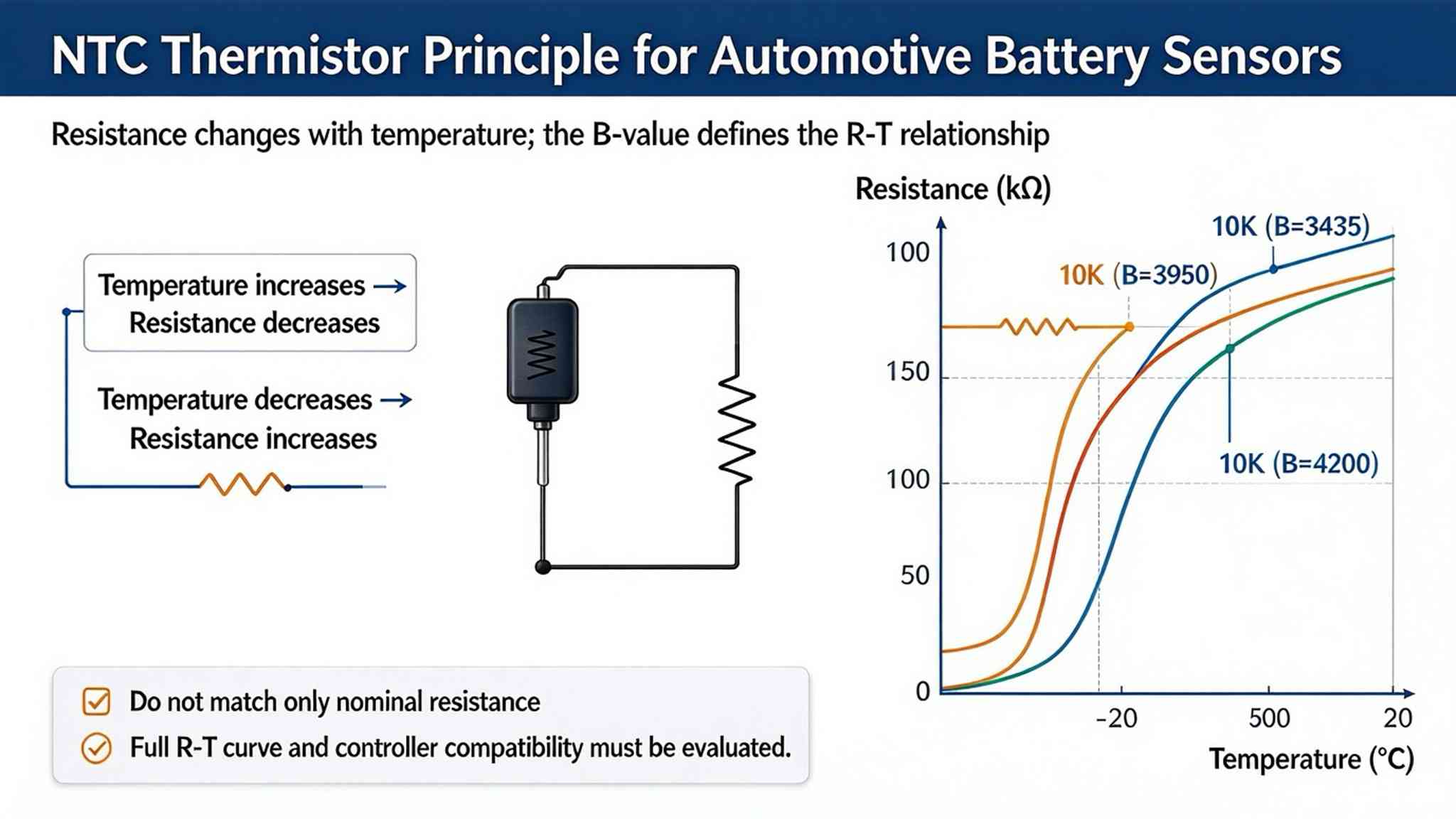
NTC stands for Negative Temperature Coefficient. Its resistance changes according to temperature:
Temperature increases → Resistance decreases
Temperature decreases → Resistance increases
The BMS or vehicle controller measures this resistance and converts it into a temperature value according to the sensor's resistance-temperature characteristics.
Because the relationship between resistance and temperature is nonlinear, the sensor must be electrically compatible with the controller.
This is why simply choosing a sensor with the same nominal resistance does not always guarantee compatibility.
Battery Temperature Sensor and BMS
The Battery Management System (BMS) monitors and manages important battery parameters such as voltage, current, temperature, state of charge, and battery protection conditions.
Battery temperature information is particularly important because charging and discharging behavior can change with temperature.
When the battery temperature changes, the BMS can use the sensor signal as one of its inputs to determine an appropriate management strategy.
For example, depending on the battery chemistry and system design, the BMS may adjust charging conditions, activate cooling equipment, or initiate thermal protection when the temperature reaches a defined limit.
The relationship can be simplified as:
Battery Temperature Sensor → Temperature Data → BMS → Battery Management
The sensor provides the measurement; the BMS makes control decisions based on that information.
Why Are NTC Thermistors Common in Automotive Battery Sensors?
NTC thermistors are widely used in automotive temperature sensing because they offer high sensitivity, compact size, fast response, and flexible electrical characteristics.
They can also be manufactured in different configurations to suit specific battery structures.
Depending on the application, an NTC battery temperature sensor may use a bare thermistor, epoxy encapsulation, plastic housing, metal probe, contact structure, or customized cable assembly.
This flexibility makes NTC technology suitable for battery monitoring in conventional vehicles, hybrid vehicles, and electric vehicles.
Understanding NTC Resistance and B-Value
For an NTC battery temperature sensor, nominal resistance and B-value are two important electrical specifications.
A 10K NTC sensor, for example, generally refers to a thermistor with a nominal resistance of 10 kΩ at its specified reference temperature, commonly 25°C.
The resistance does not remain at 10 kΩ throughout the operating range. It changes with temperature.
The B-value describes the resistance-temperature relationship of the thermistor. Two 10K NTC sensors can have different B-values and therefore produce different resistance values at the same temperature.
For automotive applications, engineers should therefore consider the complete R-T curve, rather than matching only the nominal resistance.
How to Select an Automotive Battery Temperature Sensor
The correct sensor should be selected according to both the battery system and the installation environment.
The key parameters normally include sensor type, nominal resistance, B-value, R-T characteristics, temperature range, response time, probe dimensions, mounting method, cable, connector, and controller compatibility.
The installation position is equally important. A sensor mounted near a battery terminal, cell, module, or battery housing may require a different mechanical structure or response characteristic.
The sensor should also be suitable for the actual automotive operating environment, including temperature changes, vibration, moisture, and mechanical stress.
Automotive Battery Temperature Sensor for OEM and ODM
Automotive manufacturers and battery system developers may require customized temperature sensors rather than standard components.
Focusens can develop customized NTC battery temperature sensors based on specific electrical and mechanical requirements.
Customization can include NTC resistance, B-value, tolerance, R-T characteristics, probe dimensions, housing design, cable length, connector configuration, and mounting structure.
For OEM and ODM applications, the objective is to create a sensor that fits the battery structure while providing reliable temperature feedback to the vehicle's control system.
Applications of Automotive Battery Temperature Sensors
Automotive battery temperature sensors can be used in a wide range of applications, including conventional vehicle batteries, hybrid battery systems, EV battery packs, battery modules, charging systems, and battery thermal management systems.
In hybrid and electric vehicles, temperature sensing becomes particularly important because battery temperature can influence charging, discharging, cooling, and protection strategies.
Accurate temperature feedback helps the BMS make more appropriate decisions throughout the battery's operating cycle.

FAQ
What type of sensor is commonly used for automotive battery temperature measurement?
NTC thermistors are widely used because of their high sensitivity, compact size, flexible resistance characteristics, and relatively simple electrical integration.
What does a battery temperature sensor do?
It detects battery temperature and provides an electrical signal to the relevant BMS, charging system, or vehicle controller. The information can be used for charging control, thermal management, monitoring, and protection.
Is a battery temperature sensor part of a BMS?
Battery temperature sensors are important sensing components in many BMS architectures. The sensor provides temperature data, while the BMS processes the information and manages the battery according to its control strategy.
Does a battery temperature sensor communicate directly with the BCM?
Not necessarily. Battery temperature information is more directly associated with the BMS or charging control system. Depending on the vehicle architecture, the information may also be shared with other control modules, including the BCM.
What is a 10K NTC battery temperature sensor?
A 10K NTC sensor generally has a nominal resistance of 10 kΩ at its specified reference temperature, commonly 25°C. Its resistance changes as the temperature changes.
Can automotive battery temperature sensors be customized?
Yes. NTC resistance, B-value, probe structure, cable, connector, mounting configuration, and other specifications can be customized according to the application and control system requirements.
Conclusion
The automotive battery temperature sensor is an important part of modern battery monitoring and thermal management systems.
By providing accurate temperature feedback, it helps the BMS or relevant vehicle control system manage charging, cooling, protection, and battery operation.
NTC thermistors are widely used because they provide high sensitivity and flexible mechanical and electrical configurations. However, sensor selection should consider more than nominal resistance. B-value, R-T characteristics, response time, temperature range, installation structure, and controller compatibility are all important.
For automotive OEM and ODM projects, Focusens provides customizable temperature sensing solutions designed around specific battery structures and system requirements.

Expert for Thermistors Temperature Sensors Humidity Sensors Level Sensors ; Reliable but flexible custom products development
100+ Sensing Solutions Developed Annually for Different Applications
80+ Countries Customers Serviced


