




- Product information
- Focusens Solution
- Typical Application
- Technical Specifications & Selection Guide
- How Do We Control Quality?
- Are You Facing Any of These Temperature Sensor Problems?
- Why Choose Our Magnetic Door Switch Sensor?
- Frequently Asked Questions
- Purchase history
- Customer Reviews
- Buyers Q & A
Model:Magnetic Door Switch Sensor Series
Key Feature: Non-Contact Magnetic Switching
MOQ(Standard):500 pcs
MOQ(Customized):TBD
Fucusens Solution
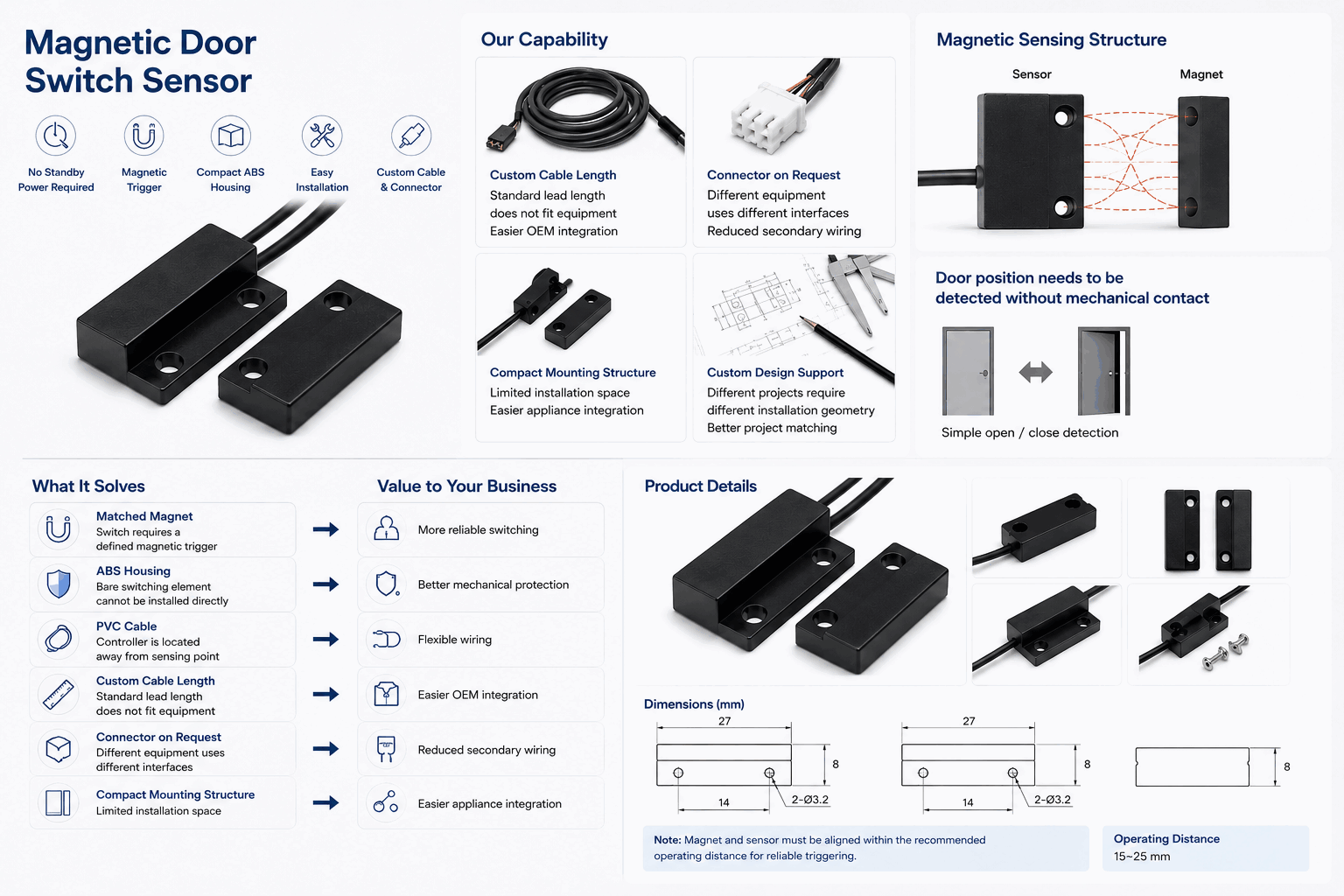
This magnetic reed switch sensor is designed to detect the open or closed position of refrigerator and freezer doors. The compact ABS housing supports screw mounting, while NO and NC contact options are available for different control requirements. Cable length, connector, housing dimensions and operating temperature range can be customized for appliance integration.
Our Capability | What It Solves | Value to Your Business |
Magnetic Sensing Structure | Door position needs to be detected without mechanical contact | Simple open / close detection |
Matched Magnet | Switch requires a defined magnetic trigger | More reliable switching |
ABS Housing | Bare switching element cannot be installed directly | Better mechanical protection |
PVC Cable | Controller is located away from sensing point | Flexible wiring |
Custom Cable Length | Standard lead length does not fit equipment | Easier OEM integration |
Connector on Request | Different equipment uses different interfaces | Reduced secondary wiring |
Compact Mounting Structure | Limited installation space | Easier appliance integration |
Custom Design Support | Different projects require different installation geometry | Better project matching |
Typical Applications
Application | Typical Customer | Recommended Solution | Why This Configuration |
Refrigerator Door Detection | Refrigerator and freezer manufacturers | Magnetic door switch sensor with matched magnet | Detects door open / closed position without mechanical contact |
Home Appliances | Appliance manufacturers | Compact ABS magnetic proximity switch | Small housing supports appliance integration |
Smart Furniture | Smart cabinet and furniture manufacturers | Magnetic door / window switch | Provides simple door-position detection |
Security Systems | Security equipment manufacturers | Magnetic proximity switch | Suitable for door / window open-close monitoring |
Industrial Equipment | Industrial control equipment manufacturers | Customized magnetic position switch | Detects cover, panel or component position |
Smart Toys / Small Devices | Electronic product manufacturers | Compact magnetic switch sensor | Simple passive switching supports small devices |

Product Structure & Selection Guide
Application — Confirm whether the sensor is used for refrigerator door, cabinet, equipment cover, appliance or another position-detection function.
Trigger Position — Confirm where the magnet and sensor will be installed.
Trigger Distance — Confirm the required switching gap between the magnet and sensor.
Contact Requirement — Confirm the contact logic and electrical load required by the controller.
Housing Size — Check available installation space.
Cable Length — Match the distance from sensor to controller.
Connector — Match the existing wiring harness or control board.
Mounting Hole Position — Confirm mounting dimensions before sample production.
3 Common Mistakes When Selecting a Magnetic Door Switch
1. Looking Only at the Sensor Housing — A magnetic door switch works together with its magnet. Better: Confirm the sensor + magnet + installation gap as one system.
2. Ignoring the Trigger Distance — Even if the housing fits, incorrect sensor-to-magnet distance may cause unreliable switching. Better: Confirm the actual installation gap and magnet position.
3. Focusing Only on Cable Length — Electrical load, connector and switching logic must also match the controller. Better: Evaluate the complete switch + magnet + cable + connector + mounting configuration.
From Magnetic Switch Element to a Ready-to-Install Door Sensor
A magnetic switch element alone is not enough for direct equipment installation. The complete sensor also needs to match:
Switch Element + Magnet + Housing + Cable + Connector + Mounting + Trigger Position
Our Capability | What It Solves | Value to Your Business |
Magnetic Sensing Structure | Door position needs to be detected without mechanical contact | Simple open / close detection |
Matched Magnet | Switch requires a defined magnetic trigger | More reliable switching |
ABS Housing | Bare switching element cannot be installed directly | Better mechanical protection |
PVC Cable | Controller is located away from sensing point | Flexible wiring |
Custom Cable Length | Standard lead length does not fit equipment | Easier OEM integration |
Connector on Request | Different equipment uses different interfaces | Reduced secondary wiring |
Compact Mounting Structure | Limited installation space | Easier appliance integration |
Custom Design Support | Different projects require different installation geometry | Better project matching |
Application | Typical Customer | Recommended Solution | Why This Configuration |
Refrigerator Door Detection | Refrigerator and freezer manufacturers | Magnetic door switch sensor with matched magnet | Detects door open / closed position without mechanical contact |
Home Appliances | Appliance manufacturers | Compact ABS magnetic proximity switch | Small housing supports appliance integration |
Smart Furniture | Smart cabinet and furniture manufacturers | Magnetic door / window switch | Provides simple door-position detection |
Security Systems | Security equipment manufacturers | Magnetic proximity switch | Suitable for door / window open-close monitoring |
Industrial Equipment | Industrial control equipment manufacturers | Customized magnetic position switch | Detects cover, panel or component position |
Smart Toys / Small Devices | Electronic product manufacturers | Compact magnetic switch sensor | Simple passive switching supports small devices |
Typical Dimensions
Housing Length — 34 mm
Housing Height — 14 mm
Mounting Hole Spacing — 17 mm
Mounting Hole — Ø4 mm
Housing Thickness / Side Dimension — approx. 7.6 mm
Cable Length — L, according to customer requirement
The sensor assembly also includes a cable section with heat-shrink tubing and connector termination. Final dimensions should be confirmed according to the approved drawing.
How the Magnetic Door Switch Works
The sensor detects a change in the magnetic field created by the movement of the magnet relative to the switch. When the magnet moves into the required sensing position, the internal contact changes state. When the magnet moves away, the contact returns according to the switch configuration.
Sensor Construction & Selection Guide
Application — Confirm whether the sensor is used for refrigerator door, cabinet, equipment cover, appliance or another position-detection function.
Trigger Position — Confirm where the magnet and sensor will be installed.
Trigger Distance — Confirm the required switching gap between the magnet and sensor.
Contact Requirement — Confirm the contact logic and electrical load required by the controller.
Housing Size — Check available installation space.
Cable Length — Match the distance from sensor to controller.
Connector — Match the existing wiring harness or control board.
Mounting Hole Position — Confirm mounting dimensions before sample production.
3 Common Mistakes When Selecting a Magnetic Door Switch
1. Choosing the Output Before Checking the Controller
A 4-20mA transmitter cannot directly replace a voltage-output transmitter if the controller input is different. Better: confirm the controller input and transmitter output together.
2. Ignoring the Temperature Range
Different configurations support different temperature ranges. Better: select the transmitter range according to the actual minimum and maximum environmental temperature.
3. Looking Only at Temperature Accuracy
This is a combined temperature and humidity transmitter. Better: evaluate Temperature Accuracy + RH Accuracy + Output + Response + Installation Environment as one complete solution.
RTD Performance Depends on Both the Sensing Element and the Complete Probe
A reliable RTD temperature probe requires: Stable RTD Element + Correct Probe Structure + Electrical Insulation + Cable Connection + Mechanical Consistency.
Incoming Material Inspection
· Magnetic switch element checked according to specification
· NdFeB magnet checked according to required configuration
· ABS housing inspected before assembly
· PVC cable verified
· Connector components checked when required
Process Control
· Switch element positioned correctly inside the housing
· Magnet and sensor matching checked
· Cable connection controlled during assembly
· Housing and cable exit inspected
· Product dimensions verified against the approved drawing
If You Are an Equipment Manufacturer / OEM
Common Problem | What It Means for Your Business |
Controller input does not match the transmitter output | Additional signal conversion may be required |
Separate temperature and humidity sensors increase installation work | More devices, wiring and installation points are needed |
Standard temperature range does not fit the project | Measurement performance may not match actual environmental conditions |
No local display is available | Commissioning and maintenance become less convenient |
Housing protection is insufficient | Humidity and dust can affect long-term operation |
Wiring mode does not match the control system | Installation and commissioning time increases |
If You Are a Distributor / Importer
Common Problem | What It Means for Your Business |
Customers require different analog outputs | One fixed-output product cannot cover all projects |
Different projects use different temperature ranges | More configuration flexibility is required |
Some customers require LCD and others do not | A single fixed version limits project coverage |
BMS and PLC interfaces differ between customers | Technical matching is required before quotation |
Customers want a complete assembly | Housing, output and wiring become part of the purchasing decision |
Sample Support
Standard Samples — Available according to current specification and stock.
Magnet Matching — Matched NdFeB magnet according to sensor configuration.
Cable Customization — Length according to equipment requirements.
Connector Matching — According to controller or wiring harness.
Housing / Mounting Review — According to equipment installation space.
Application Support — Support for refrigerator, appliance, furniture and industrial position detection.
Sample Validation Before Mass Production
We recommend checking: Switch Function → Magnet Position → Trigger Distance → Mounting → Contact Resistance → Cable → Connector
For OEM projects, the sensor and magnet should be tested in the actual installation position before mass production.
Quality Assurance
Switch Function — Checked according to confirmed specification.
Magnet Matching — Verified with the selected sensor configuration.
Housing Dimensions — According to approved drawing.
Cable Length — According to confirmed specification.
Connector — According to equipment interface.
Customized Products — Specification confirmed before production.
Finished Assembly — Functional inspection before shipment.
MOQ & Lead Time
Standard Product MOQ — Contact us for current MOQ.
Customized MOQ — Depends on cable, connector and mounting requirements.
Standard Lead Time — Contact us for current production schedule.
Customized Lead Time — Depends on the required sensor configuration.
Sample Lead Time — Confirmed after specification review.
Cooperation Process: Application Review → Switch Requirement → Magnet / Trigger Distance → Housing / Mounting → Cable / Connector → Drawing Confirmation → Sample Testing → Pilot Order → Mass Production
Q1. What is a magnetic door switch sensor?
It is a magnetic proximity switch used to detect the relative position of a door, cover or moving component.
Q2. Does the sensor require mechanical contact?
The switching action is triggered by the magnetic field between the sensor and magnet rather than by directly pressing a mechanical button.
Q3. What is the working temperature?
According to the supplied product data: -30°C to +80°C.
Q4. What housing material is used?
The supplied specification lists ABS, Black or White.
Q5. What magnet is used?
The supplied product information lists an NdFeB Magnet.
Q6. What is the typical housing size?
The supplied specification lists approximately 14 × 34 mm.
Q7. What cable material is used?
PVC, according to the supplied product data.
Q8. Can the cable length be customized?
Yes. Cable length can be configured according to equipment requirements.
Q9. Can you provide a connector?
Yes. Connector options are available on request.
Q10. Is it suitable for refrigerator door detection?
Yes. Refrigerator door detection is one of the key applications for this product.
Q11. Can the mounting design be customized?
The complete sensor configuration can be reviewed according to the customer’s installation structure.
Q12. What information is required for a quotation?
Please provide: Application + Trigger Distance + Housing / Mounting + Cable Length + Connector + Quantity.
- User name Member Level Quantity Specification Purchase Date
- Satisfaction :
-



Expert for Thermistors Temperature Sensors Humidity Sensors Level Sensors ; Reliable but flexible custom products development
100+ Sensing Solutions Developed Annually for Different Applications
80+ Countries Customers Serviced


