




- Product information
- Typical Application
- Technical Specifications & Selection Guide
- How Do We Control Quality?
- Are You Facing Any of These Temperature Sensor Problems?
- Why Choose the MFE-2 Epoxy Encapsulated Sensor?
- Frequently Asked Questions
- Purchase history
- Customer Reviews
- Buyers Q & A
Model:MFE-1 Series
Key Feature:Compact Epoxy Encapsulation
MOQ(Standard):500 pcs
MOQ(Customized):TBD
Fucusens Solution
The NTC Temperature Sensor features a 10K or 100K NTC thermistor with a 3950 Beta value and durable Kynar insulation, providing accurate and stable temperature measurement for EV battery packs, BMS and automotive thermal management. Custom probe dimensions, cable lengths and connectors are available to meet different installation requirements.
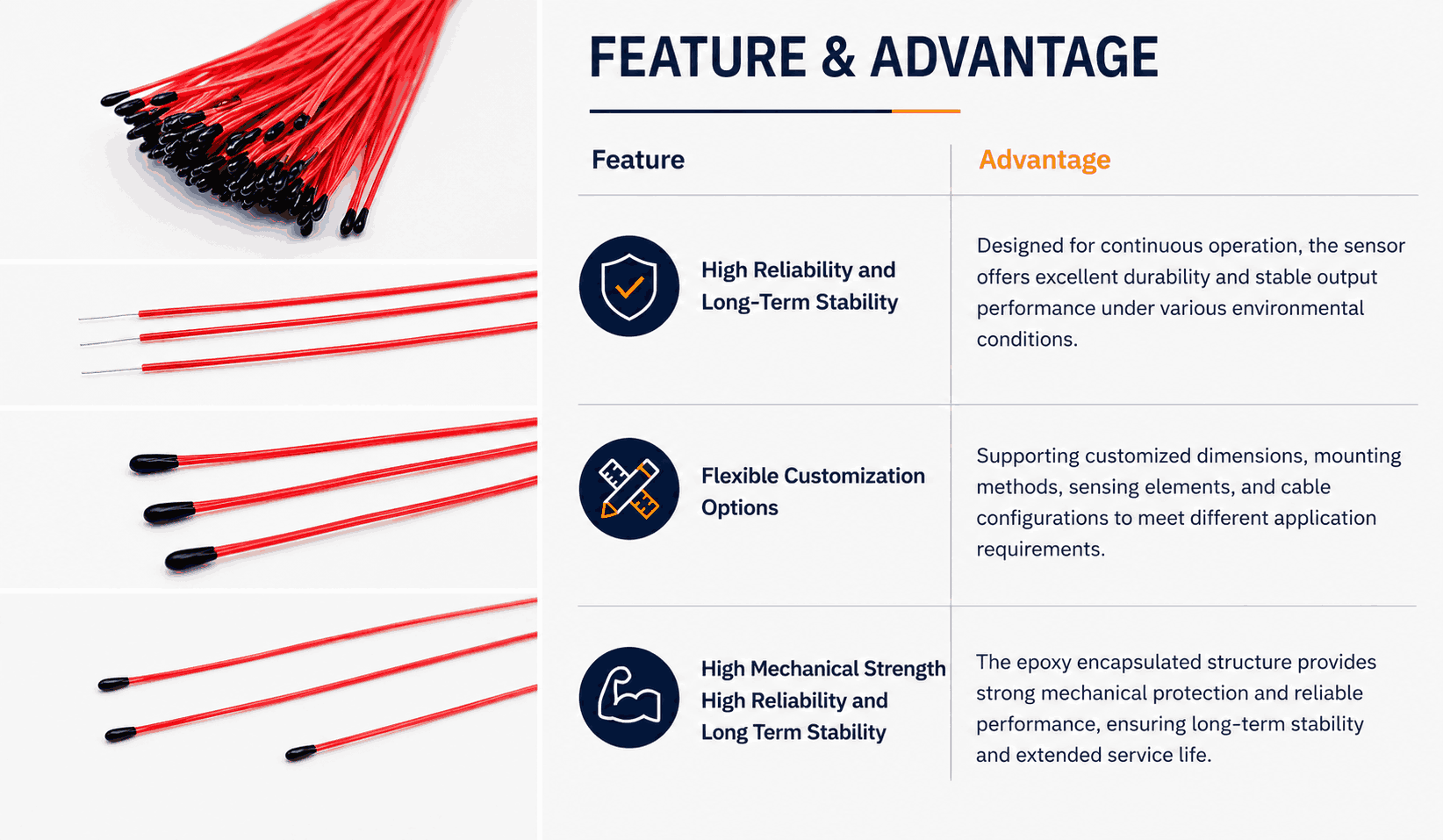
Our Capability | Value for Equipment Manufacturers | Value for Distributors / Importers |
Compact epoxy encapsulated design | Fits into limited installation space → easier product integration | Covers more compact HVAC and electronic applications |
Cost-effective sensor construction | Helps reduce component cost in volume production | More competitive positioning for high-volume markets |
NTC thermistor sensing element | Widely used for temperature monitoring and control | Easy to match common customer requirements |
IP66 protection | Protection against dust and water jets for suitable applications | Broader coverage for HVAC and environmental sensing projects |
High mechanical strength | Better protection for the sensing element during assembly and use | Fewer mechanical damage complaints |
High reliability and long-term stability | More stable temperature measurement over time | Better repeat-order potential |
Custom dimensions | Sensor can be designed around available installation space | Easier to serve different OEM customers |
Custom mounting, sensing element and material | Better integration with your product design | Greater ability to accept non-standard projects |
Typical Application:
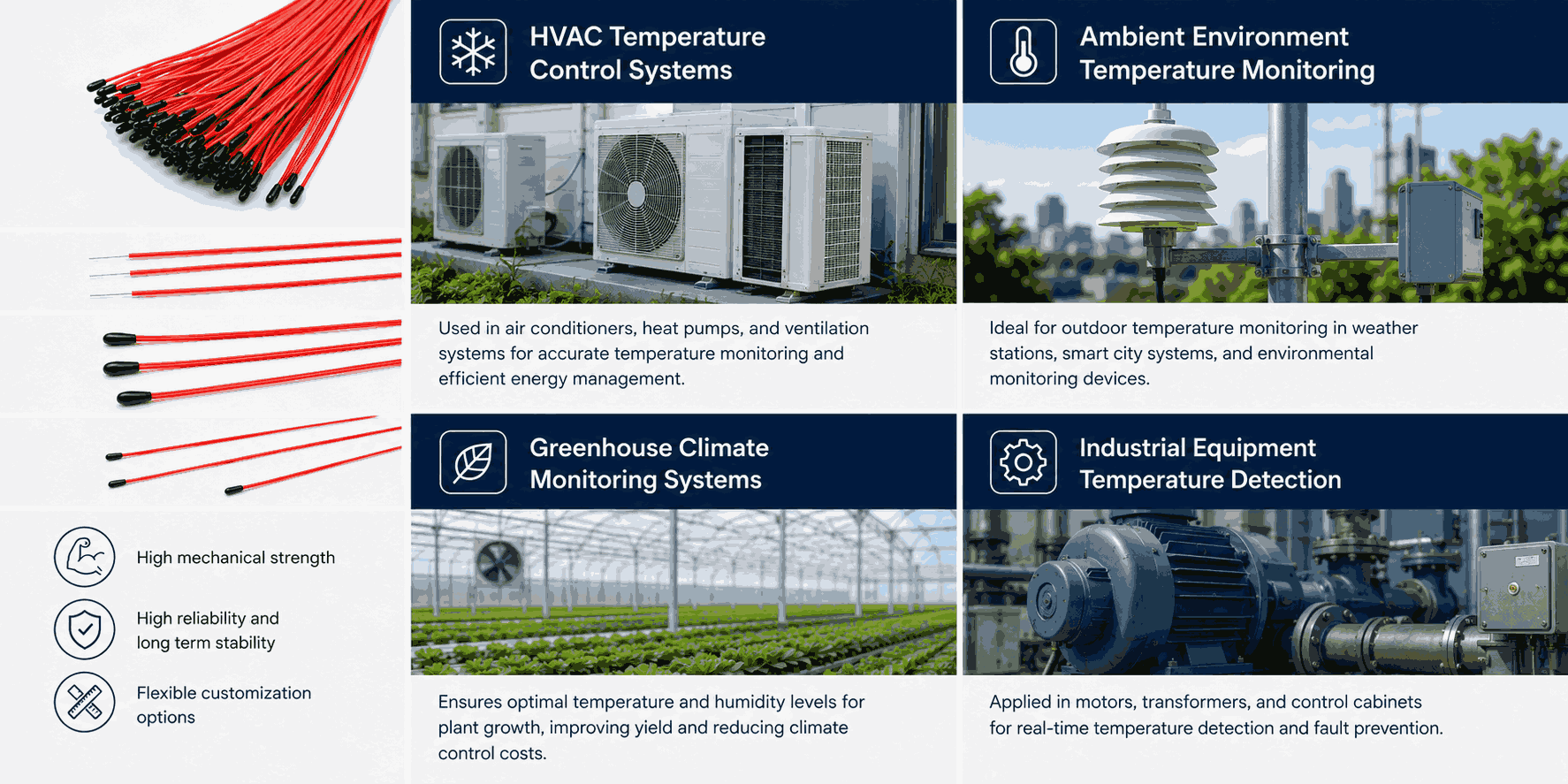
HVAC Temperature Control Systems
Accurate temperature monitoring and thermal regulation for HVAC equipment, air conditioners, heat pumps, and ventilation systems.
Ambient Environment Temperature Monitoring
Reliable ambient temperature sensing for weather stations, smart buildings, environmental monitoring, and outdoor measurement devices.
Greenhouse Climate Monitoring Systems
Continuous temperature monitoring for greenhouse climate control, improving crop growth conditions and agricultural efficiency.
Industrial Equipment Temperature Detection
Real-time temperature detection for motors, transformers, industrial machinery, and automation control systems.
HVAC Temperature Control Systems
Accurate temperature monitoring and thermal regulation for HVAC equipment, air conditioners, heat pumps, and ventilation systems.
Ambient Environment Temperature Monitoring
Reliable ambient temperature sensing for weather stations, smart buildings, environmental monitoring, and outdoor measurement devices.
Greenhouse Climate Monitoring Systems
Continuous temperature monitoring for greenhouse climate control, improving crop growth conditions and agricultural efficiency.
Industrial Equipment Temperature Detection
Real-time temperature detection for motors, transformers, industrial machinery, and automation control systems.
Technical Data
Parameter | Specification | Notes |
Product | Epoxy Encapsulated Temperature Sensor | Compact temperature sensing assembly |
Series | MFE-2 Series | Cost-effective compact sensor series |
Sensing Element | NTC Thermistor | Standard popular sensing element |
Temperature Range | -30°C to +105°C | Standard specified range |
Waterproof / Dustproof Rating | IP66 | Protection against dust and water jets |
Encapsulation Type | Epoxy Encapsulation | Compact and economical construction |
Response Time | T0.63 = 30 s in water at 0.4 m/s | Under specified test conditions |
Dissipation Factor | 2.5 mW/°C | Standard technical data |
Long-Term Stability | Drift ≤3% after 1,000 h heat/cold storage at 80°C / -30°C | Based on specified storage conditions |
Dielectric Strength | 1500 VAC | Electrical insulation performance |
Insulation Resistance | 100 MΩ @ 500 VDC | High insulation resistance |
Sensor Size | Customizable | According to available installation space |
Mounting Type | Customizable | According to application |
Sensing Type | Customizable | NTC and other sensing elements according to project needs |
Material | Customizable | According to application conditions |
Incoming Material Inspection
· NTC thermistor elements are checked according to the required electrical specifications.
· Epoxy encapsulation materials are inspected before production.
· Lead wires and terminals are checked according to customer requirements.
· Customized sensing elements are verified against approved specifications.
Process Control
· Thermistor-to-wire connections are properly secured before encapsulation.
· Epoxy dispensing and curing are controlled to achieve consistent encapsulation.
· Sensor dimensions are checked against approved drawings.
· Customized mounting structures are produced according to confirmed specifications
Finished Product Inspection
Test Item | Specification | Purpose |
NTC Resistance | According to confirmed NTC specification | Verify electrical compatibility |
Waterproof / Dustproof | IP66 | Confirm protection performance |
Response Time | T0.63 = 30 s in water at 0.4 m/s | Verify thermal response under specified conditions |
Insulation Resistance | 100 MΩ @ 500 VDC | Verify electrical insulation |
Dielectric Strength | 1500 VAC | Check insulation reliability |
Appearance | Epoxy encapsulation complete and free from obvious defects | Ensure consistent encapsulation |
Dimensions | According to approved drawing | Ensure installation compatibility |
If You Are an Equipment Manufacturer / OEM
Common Problem | What It Means for Your Business |
Standard sensors take up too much installation space | Compact HVAC controllers, air ducts or electronic assemblies often have limited mounting space, making large sensor housings difficult to install. |
Sensor cost is too high for volume production | When a temperature sensor is used in large quantities, unnecessary housing or sealing structures can significantly increase total purchasing cost. |
Temperature readings drift over time | Poor encapsulation or unstable sensing elements can cause resistance drift and affect temperature control performance. |
Standard sensor dimensions do not fit your design | Different products require different sensor sizes, mounting positions and cable configurations. |
Mechanical protection is insufficient | Exposed thermistors or weak encapsulation can be damaged during assembly, handling or long-term use. |
You need a customized sensor, but suppliers only offer standard models | Your engineering team has to redesign the product around the sensor instead of having the sensor designed around your application. |
If You Are a Distributor / Importer
Common Problem | What It Means for Your Business |
Customers require many different NTC specifications | Different HVAC and environmental monitoring customers may use different resistance values, B values and dimensions. |
Standard products are difficult to differentiate | When every supplier offers the same basic probe, price competition becomes more intense. |
Your supplier cannot handle custom projects | You may lose OEM customers that require special sensor sizes, mounting methods or materials. |
Product cost is too high for price-sensitive markets | Complex sensor structures may make it difficult to compete in high-volume HVAC and ambient temperature applications. |
Inconsistent quality creates repeated customer complaints | Resistance drift or mechanical damage can reduce customer confidence and repeat orders. |
Comparison | Typical Standard Sensor | MFE-2 Series | Value to Your Business |
Sensor Structure | Larger or more complex housing | Compact epoxy encapsulation | Saves installation space |
Cost | Higher structural cost | Cost-effective design | Better suited for volume production |
Protection | Basic component protection | IP66 | Improved environmental protection |
Sensing Element | Fixed thermistor specification | NTC thermistor selected according to application | Better electrical compatibility |
Sensor Size | Standard size only | Custom size available | Fits existing product design |
Mounting | Limited mounting options | Custom mounting design | Easier assembly |
Mechanical Strength | Depends on housing | High mechanical strength | Better resistance to handling and assembly stress |
Long-Term Stability | Varies by supplier | High reliability and long-term stability | Reduced risk of resistance drift |
Material Options | Limited | Material can be customized | Better application flexibility |
Customization | Limited | Size, mounting, sensing type and material can be customized | Better support for OEM/ODM projects |
Q1: What is an epoxy encapsulated NTC temperature sensor?
A: An epoxy encapsulated NTC sensor uses epoxy resin to protect and insulate the thermistor sensing element. Compared with larger probe structures, it offers a compact and cost-effective solution for HVAC and ambient temperature measurement.
Q2: What is the protection rating of the MFE-2 Series?
A: The specified waterproof and dustproof rating is IP66. If your application has special exposure conditions, please provide details before selecting the sensor structure.
Q3: What temperature range does the MFE-2 support?
A: The specified operating temperature range is -30°C to +105°C.
Q4: Can you customize the sensor dimensions?
A: Yes. Sensor size, mounting type, sensing type and material can be customized according to the application conditions.
Q5: What NTC resistance should I choose?
A: That depends on your control circuit. Please provide R25 resistance, B value and resistance tolerance. If you are replacing an existing sensor, send us its datasheet or R-T table.
Q6: Can you customize the mounting structure?
A: Yes. Mounting requirements can be customized according to your installation conditions and available space.
Q7: Is epoxy encapsulation suitable for HVAC?
A: Yes. Its compact size and cost-effective construction make it suitable for many HVAC and ambient temperature sensing applications. Final selection should still be based on the actual operating environment.
Q8: Can you supply different NTC specifications?
A: Yes. The sensing element can be selected according to project requirements. Please provide the required resistance, B value and tolerance.
Q9: Can you make different sensor sizes for different customers?
A: Yes. Customization flexibility is one of the main advantages of the MFE-2 Series.
Q10: Can you replace an existing customer sensor?
A: Yes. Send us the existing drawing, datasheet, photos, NTC parameters or sample. We can compare the electrical and mechanical requirements.
Q11: Why choose epoxy encapsulation instead of a larger probe?
A: If the application does not require a heavy-duty metal probe or higher-level sealing structure, epoxy encapsulation can offer a better balance of cost, compact size, mechanical protection and customization.
Q12: What information do you need for a quotation?
A: For a faster quotation, please provide the application, NTC specification, operating temperature, sensor dimensions, mounting requirement, cable/connection and quantity.
Q13: Can I test samples before mass production?
A: Yes. For customized sensors, sample testing is recommended to confirm electrical parameters, dimensions, installation fit and actual application performance before volume production.
- User name Member Level Quantity Specification Purchase Date
- Satisfaction :
-



Expert for Thermistors Temperature Sensors Humidity Sensors Level Sensors ; Reliable but flexible custom products development
100+ Sensing Solutions Developed Annually for Different Applications
80+ Countries Customers Serviced


