




- Product information
- Focusens Solution
- Typical Application
- Technical Specifications & Selection Guide
- How Do We Control Quality?
- Are You Facing Any of These Temperature Sensor Problems?
- Why Choose Our RTD Temperature Sensor Probe?
- Frequently Asked Questions
- Purchase history
- Customer Reviews
- Buyers Q & A
Model:FWZ Series
Key Feature:High Accuracy & Excellent Stability
MOQ(Standard):500 pcs
MOQ(Customized):TBD
Fucusens Solution
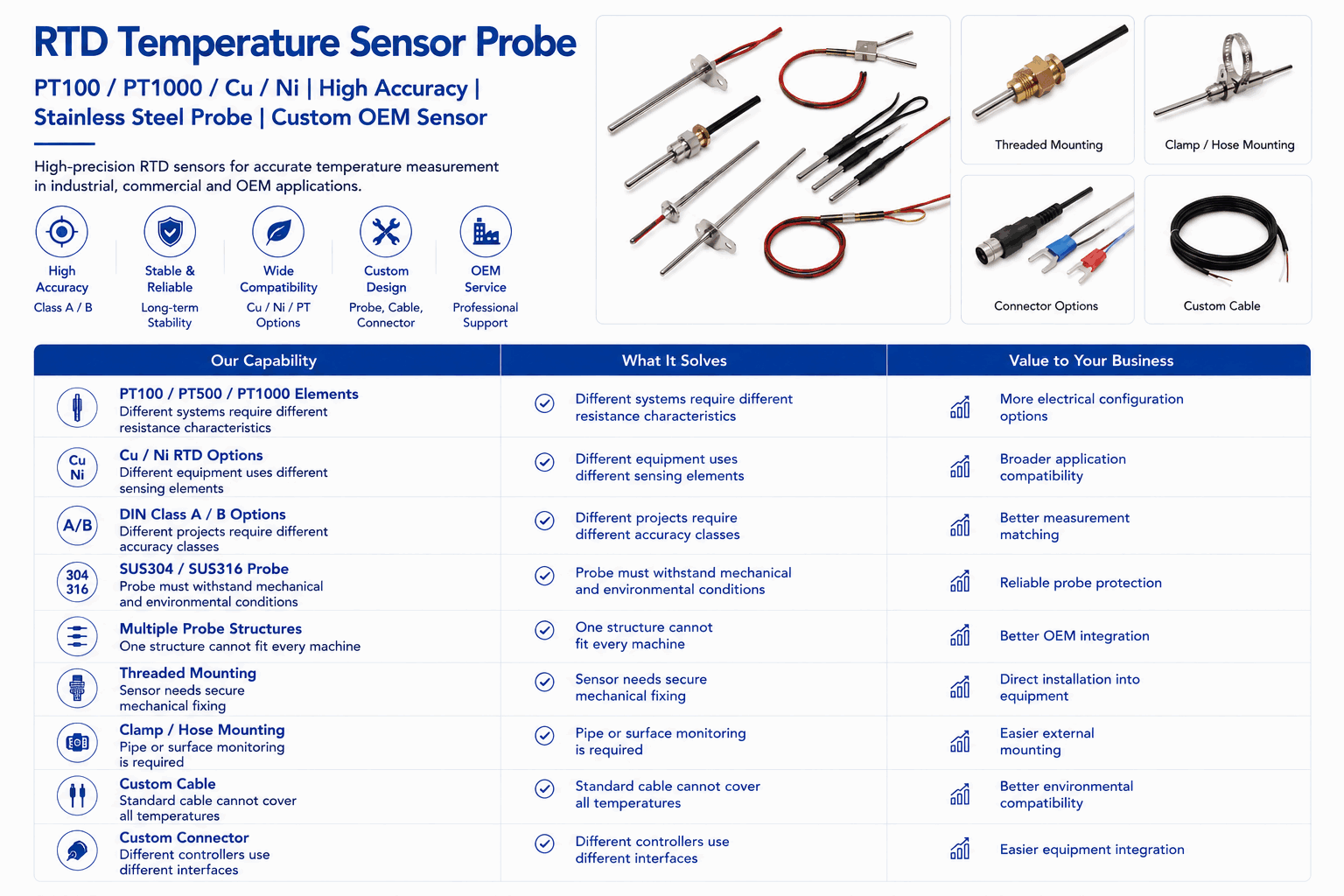
Selecting PT100 or PT1000 is only the first step. A complete RTD sensor assembly also needs to match: RTD Element + Probe Material + Probe Dimensions + Mounting Structure + Cable + Connector + Operating Environment.
Our Capability | What It Solves | Value to Your Business |
PT100 / PT500 / PT1000 Elements | Different systems require different resistance characteristics | More electrical configuration options |
Cu / Ni RTD Options | Different equipment uses different sensing elements | Broader application compatibility |
DIN Class A / B Options | Different projects require different accuracy classes | Better measurement matching |
SUS304 / SUS316 Probe | Probe must withstand mechanical and environmental conditions | Reliable probe protection |
Multiple Probe Structures | One structure cannot fit every machine | Better OEM integration |
Threaded Mounting | Sensor needs secure mechanical fixing | Direct installation into equipment |
Clamp / Hose Mounting | Pipe or surface monitoring is required | Easier external mounting |
Custom Cable | Standard cable cannot cover all temperatures | Better environmental compatibility |
Custom Connector | Different controllers use different interfaces | Easier equipment integration |
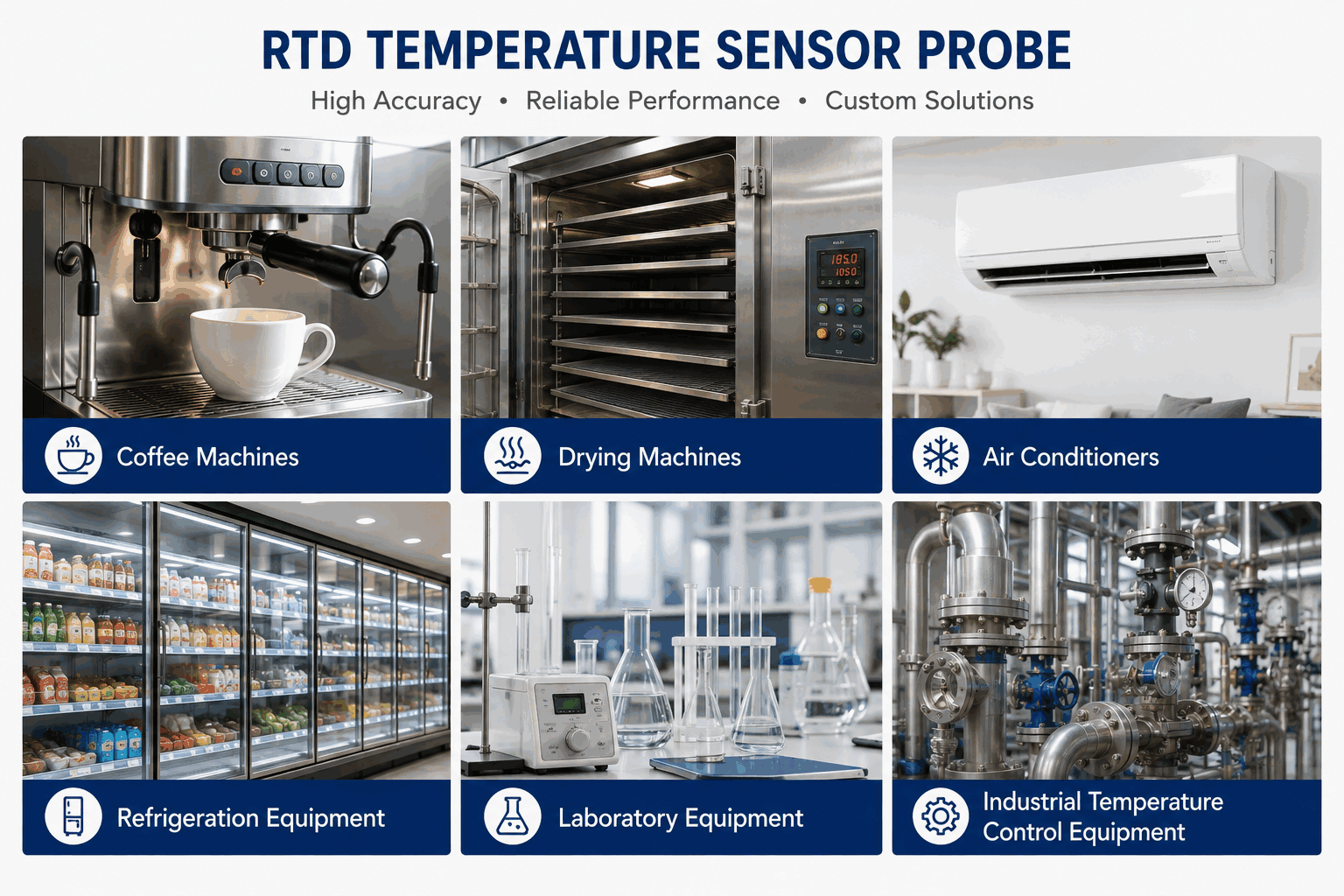
Typical Applications
Application | Typical Customer | Recommended Solution | Why This Configuration |
Coffee Machines | Commercial and household coffee equipment manufacturers | Compact PT100 / PT1000 RTD probe | Stable resistance measurement supports beverage heating control |
Drying Machines | Drying and heating equipment manufacturers | High-temperature RTD probe | Suitable probe and cable structure supports elevated-temperature monitoring |
Air Conditioners | HVAC equipment manufacturers | Customized RTD temperature sensor | Multiple probe structures support HVAC temperature feedback |
Refrigeration Equipment | Refrigerator and refrigeration equipment manufacturers | Stainless steel RTD probe | Suitable for equipment temperature monitoring |
Laboratory Equipment | Laboratory and test equipment manufacturers | Precision RTD probe | DIN Class A / B options support measurement applications |
Industrial Temperature Control Equipment | Industrial equipment manufacturers | Threaded / flange RTD sensor | Secure mounting and wide configuration options support process monitoring |
Technical Specifications & Selection Guide
Parameter | Specification | Selection Notes |
Product Type | RTD Temperature Sensor Probe | Resistance temperature measurement |
Sensing Element | PT100 / PT500 / PT1000 / Cu / Ni | According to controller |
Temperature Range | Depends on probe structure and element | Multiple options available |
Accuracy | DIN Class A or B | According to required precision |
Response Time | Approx. 10s under specified configuration | Depends on probe structure |
Insulation Resistance | 100MΩ | According to supplied data |
Cable Material | PVC / Teflon / Silicone / Fiberglass | According to operating temperature |
Housing Material | SUS304 / SUS316 | According to environment |
Probe Diameter | Customizable | Typical structures shown in original data |
Probe Length | Customizable | According to sensing position |
Mounting | Straight / Threaded / Flange / Clamp / Custom | According to equipment |
Product Structure & Selection Guide
RTD Element — Choose PT100, PT500, PT1000, Cu or Ni according to the controller and required resistance characteristics.
Accuracy Class — Confirm whether DIN Class A or Class B is required.
Temperature Range — Confirm the normal and maximum operating temperature.
Probe Diameter & Length — Match the sensing position and installation space.
Mounting Structure — Select straight probe, thread, flange, clamp or custom mounting.
Housing Material — SUS304 or SUS316 according to environment.
Cable Material — Select according to operating temperature and installation conditions.
Cable Length — Match equipment wiring distance.
Connector — Match the controller or existing wiring harness.
3 Common Mistakes When Selecting an RTD Sensor
1. Choosing PT100 / PT1000 Without Checking the Controller: PT100 and PT1000 have different nominal resistance values. Better: Confirm the RTD element required by the control system.
2. Looking Only at the RTD Element Temperature Range: The complete probe may use cable, insulation and mounting materials with different temperature limits. Better: Evaluate the RTD Element + Probe + Cable + Mounting together.
3. Ignoring Probe Structure and Installation: A high-accuracy RTD element cannot perform correctly if the probe does not reach or contact the actual measurement point properly. Better: Confirm probe dimensions + mounting + sensing position before sample production.

Selecting PT100 or PT1000 is only the first step. A complete RTD sensor assembly also needs to match: RTD Element + Probe Material + Probe Dimensions + Mounting Structure + Cable + Connector + Operating Environment.
Our Capability | What It Solves | Value to Your Business |
PT100 / PT500 / PT1000 Elements | Different systems require different resistance characteristics | More electrical configuration options |
Cu / Ni RTD Options | Different equipment uses different sensing elements | Broader application compatibility |
DIN Class A / B Options | Different projects require different accuracy classes | Better measurement matching |
SUS304 / SUS316 Probe | Probe must withstand mechanical and environmental conditions | Reliable probe protection |
Multiple Probe Structures | One structure cannot fit every machine | Better OEM integration |
Threaded Mounting | Sensor needs secure mechanical fixing | Direct installation into equipment |
Clamp / Hose Mounting | Pipe or surface monitoring is required | Easier external mounting |
Custom Cable | Standard cable cannot cover all temperatures | Better environmental compatibility |
Custom Connector | Different controllers use different interfaces | Easier equipment integration |
Application | Typical Customer | Recommended Solution | Why This Configuration |
Coffee Machines | Commercial and household coffee equipment manufacturers | Compact PT100 / PT1000 RTD probe | Stable resistance measurement supports beverage heating control |
Drying Machines | Drying and heating equipment manufacturers | High-temperature RTD probe | Suitable probe and cable structure supports elevated-temperature monitoring |
Air Conditioners | HVAC equipment manufacturers | Customized RTD temperature sensor | Multiple probe structures support HVAC temperature feedback |
Refrigeration Equipment | Refrigerator and refrigeration equipment manufacturers | Stainless steel RTD probe | Suitable for equipment temperature monitoring |
Laboratory Equipment | Laboratory and test equipment manufacturers | Precision RTD probe | DIN Class A / B options support measurement applications |
Industrial Temperature Control Equipment | Industrial equipment manufacturers | Threaded / flange RTD sensor | Secure mounting and wide configuration options support process monitoring |
Technical Data
Parameter | Specification | Selection Notes |
Product Type | RTD Temperature Sensor Probe | Resistance temperature measurement |
Sensing Element | PT100 / PT500 / PT1000 / Cu / Ni | According to controller |
Temperature Range | Depends on probe structure and element | Multiple options available |
Accuracy | DIN Class A or B | According to required precision |
Response Time | Approx. 10s under specified configuration | Depends on probe structure |
Insulation Resistance | 100MΩ | According to supplied data |
Cable Material | PVC / Teflon / Silicone / Fiberglass | According to operating temperature |
Housing Material | SUS304 / SUS316 | According to environment |
Probe Diameter | Customizable | Typical structures shown in original data |
Probe Length | Customizable | According to sensing position |
Mounting | Straight / Threaded / Flange / Clamp / Custom | According to equipment |
Sensor Construction & Selection Guide
Temperature Range — Confirm normal and maximum operating temperature.
Required Accuracy — Confirm the measurement accuracy required by the application.
Output Interface — Make sure the controller accepts the LM35 analog voltage signal.
Probe Structure & Size — Match the installation space and sensing position.
Housing Material — Select according to mechanical and environmental requirements.
Cable Insulation / Gauge / Length — Match temperature, wiring distance and equipment design.
Connector / Accessories — Match the existing controller or wiring harness.
3 Common Mistakes When Selecting an RTD Sensor
1. Choosing PT100 / PT1000 Without Checking the Controller: PT100 and PT1000 have different nominal resistance values. Better: Confirm the RTD element required by the control system.
2. Looking Only at the RTD Element Temperature Range: The complete probe may use cable, insulation and mounting materials with different temperature limits. Better: Evaluate the RTD Element + Probe + Cable + Mounting together.
3. Ignoring Probe Structure and Installation: A high-accuracy RTD element cannot perform correctly if the probe does not reach or contact the actual measurement point properly. Better: Confirm probe dimensions + mounting + sensing position before sample production.
RTD Performance Depends on Both the Sensing Element and the Complete Probe
A reliable RTD temperature probe requires: Stable RTD Element + Correct Probe Structure + Electrical Insulation + Cable Connection + Mechanical Consistency.
Incoming Material Inspection
• RTD sensing elements checked according to specification
• SUS304 / SUS316 probe materials inspected
• Cable material verified according to temperature requirement
• Connectors and terminals checked before production
Process Control
• RTD-to-wire connection controlled during assembly
• Sensing element position maintained according to design
• Probe dimensions checked against approved drawing
• Cable length and insulation verified
• Mounting structure checked during production
Finished Product Inspection
Test Item | Verification |
RTD Resistance | According to selected sensing element |
Temperature Measurement | According to confirmed test requirement |
Accuracy Class | According to confirmed RTD specification |
Insulation Resistance | According to technical requirement |
Probe Dimensions | According to approved drawing |
Cable Length | According to specification |
Mounting Structure | According to confirmed design |
Appearance | Finished assembly inspection |
If You Are an Equipment Manufacturer / OEM
Common Problem | What It Means for Your Business |
RTD element does not match the controller | Incorrect PT100 / PT1000 selection causes system incompatibility |
Standard probe dimensions do not fit | Different equipment requires different diameter and length |
Mounting structure does not match | Additional fabrication increases installation work |
Cable cannot withstand the application temperature | Cable becomes the weak point of the sensor assembly |
Accuracy requirement is unclear | Wrong accuracy class may increase cost or fail measurement requirements |
Probe does not reach the actual sensing point | Temperature feedback may not represent the real process condition |
If You Are a Distributor / Importer
Common Problem | What It Means for Your Business |
Customers request different RTD elements | One standard PT100 product cannot cover all projects |
Customers need different probe structures | Fixed designs limit OEM opportunities |
Different projects require different mounting methods | Thread, flange and clamp structures may all be required |
Customers have different temperature ranges | Probe and cable must be selected accordingly |
Technical matching takes too long | Electrical and mechanical requirements must be confirmed together |
Sample Support
Standard Samples — Available according to current specifications and stock.
RTD Selection — PT100 / PT500 / PT1000 / Cu / Ni according to controller requirements.
Accuracy Selection — DIN Class A / B according to project requirements.
Customized Samples — Available after probe specification confirmation.
Probe Customization — Diameter, length and mounting according to application.
Cable Customization — Material and length according to operating temperature.
Connector Matching — According to equipment interface.
Sample Validation Before Mass Production
We recommend checking: RTD Element → Resistance → Accuracy → Probe Dimensions → Mounting → Cable → Connector → Installation. Sample testing in the actual equipment is recommended before pilot production.
Quality Assurance
RTD Element — According to confirmed specification.
Accuracy Class — According to confirmed requirement.
Probe Material & Dimensions — According to approved drawing.
Cable — According to confirmed temperature and installation requirement.
Mounting Structure — According to equipment interface.
Customized Products — Specification confirmed before mass production.
Finished Assembly — Functional inspection before shipment.
MOQ & Lead Time
Standard Product MOQ — Contact us for current MOQ.
Customized MOQ — Depends on RTD, probe and mounting requirements.
Standard Lead Time — Contact us for current production schedule.
Customized Lead Time — Depends on probe, cable and connector configuration.
Sample Lead Time — Confirmed after specification review.
Cooperation Process: Application Review → RTD Element Confirmation → Accuracy & Temperature Range → Probe / Mounting Design → Cable / Connector → Drawing Approval → Sample Testing → Pilot Order → Mass Production
Q1. What is an RTD temperature sensor?
An RTD uses the predictable resistance change of a sensing element to measure temperature.
Q2. What RTD elements are available?
According to the supplied product range: PT100 / PT500 / PT1000 / Cu / Ni.
Q3. What is the difference between PT100 and PT1000?
PT100 has a nominal resistance of 100Ω at 0°C, while PT1000 has 1000Ω at 0°C. The correct option should match the customer's controller.
Q4. What accuracy classes are available?
The supplied information includes DIN Class A / Class B depending on the selected sensor configuration.
Q5. What temperature range is available?
The range depends on the selected RTD element, probe structure and cable. The supplied product range includes configurations from low temperatures up to several hundred degrees Celsius.
Q6. Can you provide SUS304 or SUS316 probes?
Yes. Both SUS304 and SUS316 are listed as housing options.
Q7. Can the probe dimensions be customized?
Yes. Probe diameter and length can be configured according to equipment requirements.
Q8. What mounting options are available?
Available structures include Straight Probe / Threaded / Flange / Clamp / Custom.
Q9. Can cable material and length be customized?
Yes. Different cable types and lengths can be selected according to operating temperature and equipment requirements.
Q10. Can you match an existing RTD sensor?
Yes. Please send Existing Sensor / Drawing / RTD Type / Probe Dimensions / Cable / Connector.
Q11. What information is required for a quotation?
Please provide Application + RTD Element + Accuracy Class + Temperature Range + Probe Dimensions + Mounting + Cable + Connector + Quantity.
- User name Member Level Quantity Specification Purchase Date
- Satisfaction :
-



Expert for Thermistors Temperature Sensors Humidity Sensors Level Sensors ; Reliable but flexible custom products development
100+ Sensing Solutions Developed Annually for Different Applications
80+ Countries Customers Serviced


