




- Product information
- Focusens Solution
- Typical Application
- Technical Specifications & Selection Guide
- How Do We Control Quality?
- Are You Facing Any of These Temperature Sensor Problems?
- Why Choose Our Float Level Switch Sensor?
- Frequently Asked Questions
- Purchase history
- Customer Reviews
- Buyers Q & A
Model:Magnetic Float Level Switch Series
Key Feature:
Magnetic Float Switching
MOQ(Standard):500 pcs
MOQ(Customized):TBD
Fucusens Solution
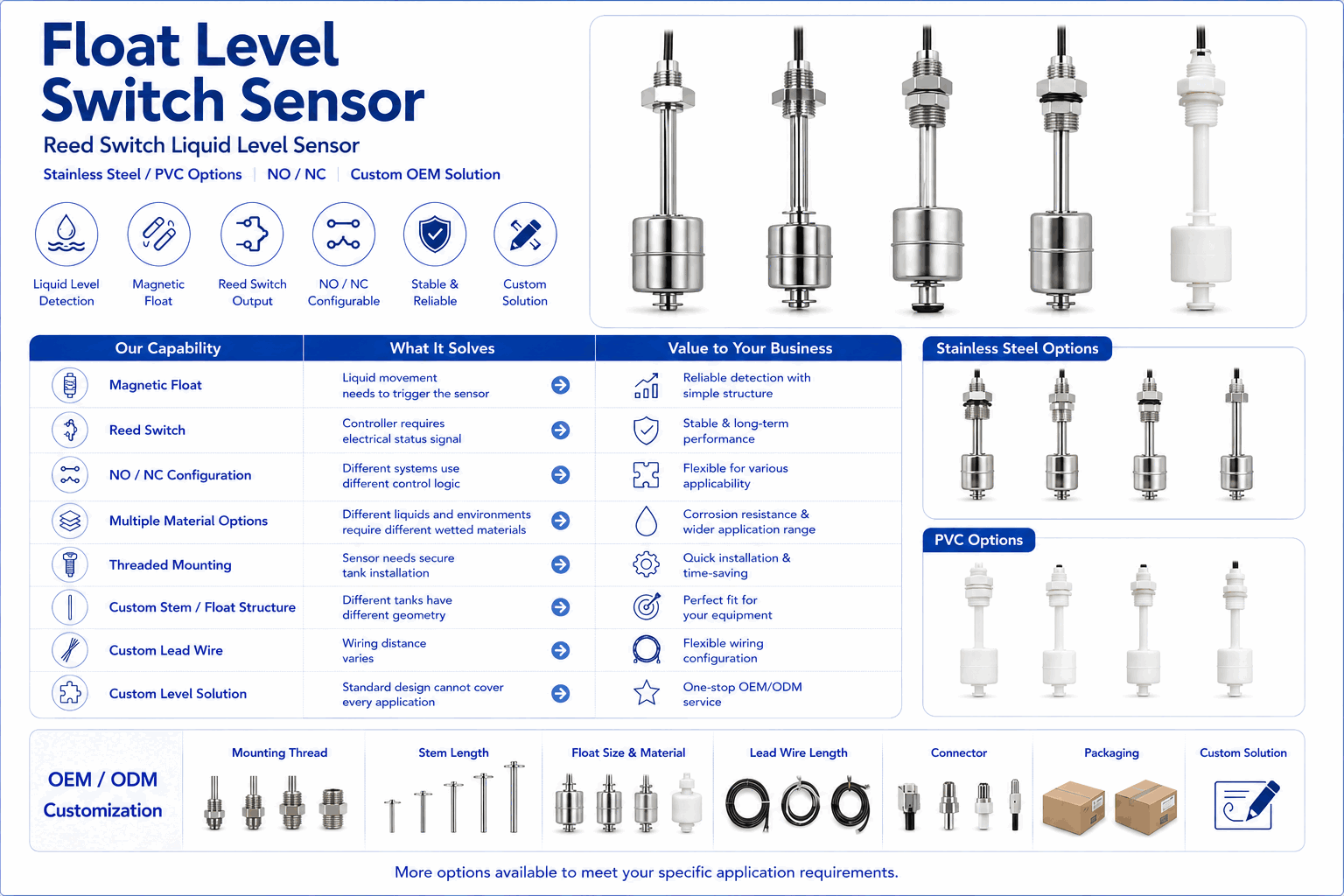
From Reed Switch to a Ready-to-Install Liquid Level Sensor
A reed switch alone cannot directly provide reliable liquid level detection. The complete assembly must match: Reed Switch + Magnetic Float + Stem + Stopper + Mounting + Cable + Liquid Environment.
Our Capability | What It Solves | Value to Your Business |
Magnetic Float | Liquid movement needs to trigger the sensor | Converts liquid-level change into float movement |
Reed Switch | Controller requires electrical status signal | Provides simple switching output |
NO / NC Configuration | Different systems use different control logic | Better controller compatibility |
Multiple Material Options | Different liquids and environments require different wetted materials | Stainless steel / PVC options for better application matching |
Threaded Mounting | Sensor needs secure tank installation | Easier mechanical integration |
Custom Stem / Float Structure | Different tanks have different geometry | Better OEM matching |
Custom Lead Wire | Wiring distance varies | Easier equipment assembly |
Custom Level Solution | Standard design cannot cover every application | Application-specific configuration |
Typical Applications
Application | Typical Customer | Recommended Solution | Why This Configuration |
Water Tanks | Tank and water-system manufacturers | Stainless steel or PVC float level switch | Material can be selected according to water quality, installation and project requirements |
Industrial Liquid Tanks | Industrial equipment manufacturers | Customized stainless steel / PVC float level switch | Material, stem and mounting can be matched to the liquid and tank structure |
Water Treatment Equipment | Water-treatment system manufacturers | PVC or stainless steel float level sensor | Material selection supports different water-treatment and liquid-control environments |
Home Appliances | Appliance manufacturers | Compact float level switch | Small structure supports internal liquid-level detection |
Pumps & Reservoirs | Pump and fluid-control manufacturers | NO / NC float switch | Can provide level status for pump-control logic |
Automation Equipment | Machinery and control-system manufacturers | Customized liquid level switch | Simple contact signal supports controller integration |
Product Structure & Selection Guide
Liquid Type — Tell us the liquid being measured so wetted-material compatibility can be evaluated.
Material Selection — Stainless steel or PVC can be selected according to the liquid, temperature, corrosion resistance and application requirements.
Switching Level — Confirm the liquid level at which the controller needs an ON/OFF signal.
NO / NC Logic — Confirm the required electrical state at low and high liquid levels.
Installation Direction — Confirm vertical installation position and available mounting space.
Mounting Thread — Provide the tank opening or thread requirement.
Stem Length — Match the required switching position inside the tank.
Float Size — Confirm available internal space and liquid conditions.
Cable Length — Match the distance to the controller.
Electrical Load — Provide the controller or relay input requirement.
3 Common Mistakes When Selecting a Float Level Switch
1. Selecting Only by Float Size
A float that physically fits the tank does not necessarily provide the correct switching level.
Better: Confirm Tank Structure + Installation Position + Stem Length + Switching Level.
2. Ignoring NO / NC Logic
The same mechanical installation can produce different control behavior depending on the required contact logic.
Better: Tell us what signal is required when the liquid is below, at or above the target level.
3. Ignoring Liquid Compatibility
The sensor is directly exposed to the measured liquid.
Better: Evaluate Liquid + Wetted Material + Temperature + Pressure + Float Movement before finalizing the sensor.
From Reed Switch to a Ready-to-Install Liquid Level Sensor
A reed switch alone cannot directly provide reliable liquid level detection. The complete assembly must match: Reed Switch + Magnetic Float + Stem + Stopper + Mounting + Cable + Liquid Environment.
Our Capability | What It Solves | Value to Your Business |
Magnetic Float | Liquid movement needs to trigger the sensor | Converts liquid-level change into float movement |
Reed Switch | Controller requires electrical status signal | Provides simple switching output |
NO / NC Configuration | Different systems use different control logic | Better controller compatibility |
Multiple Material Options | Different liquids and environments require different wetted materials | Stainless steel / PVC options for better application matching |
Threaded Mounting | Sensor needs secure tank installation | Easier mechanical integration |
Custom Stem / Float Structure | Different tanks have different geometry | Better OEM matching |
Custom Lead Wire | Wiring distance varies | Easier equipment assembly |
Custom Level Solution | Standard design cannot cover every application | Application-specific configuration |
Application | Typical Customer | Recommended Solution | Why This Configuration |
Water Tanks | Tank and water-system manufacturers | Stainless steel or PVC float level switch | Material can be selected according to water quality, installation and project requirements |
Industrial Liquid Tanks | Industrial equipment manufacturers | Customized stainless steel / PVC float level switch | Material, stem and mounting can be matched to the liquid and tank structure |
Water Treatment Equipment | Water-treatment system manufacturers | PVC or stainless steel float level sensor | Material selection supports different water-treatment and liquid-control environments |
Home Appliances | Appliance manufacturers | Compact float level switch | Small structure supports internal liquid-level detection |
Pumps & Reservoirs | Pump and fluid-control manufacturers | NO / NC float switch | Can provide level status for pump-control logic |
Automation Equipment | Machinery and control-system manufacturers | Customized liquid level switch | Simple contact signal supports controller integration |
Technical Data
Parameter | Specification | Selection Notes |
Product Type | Float Level Switch Sensor | Point liquid-level detection |
Detection Principle | Magnetic Float + Reed Switch | Magnetic activation inside assembly |
Output Type | Switch Contact | ON / OFF level signal |
Switch Configuration | Normally Open / Normally Closed | According to control logic |
Installation | Vertical Mounting | According to supplied structure |
Main Structure | Stainless Steel / PVC | Select according to liquid, temperature and chemical compatibility |
Float Type | Magnetic Float | Moves with liquid level |
Sensing Element | Reed Switch | Activated by float magnet |
Liquid Type | Compatible liquids, including non-conductive liquids | Confirm material compatibility |
Lead Wire | Customizable | According to equipment |
Mounting Structure | Threaded / Custom | According to tank design |
Switching Level | According to float and stem configuration | Confirm before production |
NO / NC | Available according to configuration | Match controller |
Sensor Construction & Selection Guide
Liquid Type — Tell us the liquid being measured so wetted-material compatibility can be evaluated.
Material Selection — Stainless steel or PVC can be selected according to the liquid, temperature, corrosion resistance and application requirements.
Switching Level — Confirm the liquid level at which the controller needs an ON/OFF signal.
NO / NC Logic — Confirm the required electrical state at low and high liquid levels.
Installation Direction — Confirm vertical installation position and available mounting space.
Mounting Thread — Provide the tank opening or thread requirement.
Stem Length — Match the required switching position inside the tank.
Float Size — Confirm available internal space and liquid conditions.
Cable Length — Match the distance to the controller.
Electrical Load — Provide the controller or relay input requirement.
3 Common Mistakes When Selecting a Float Level Switch
1. Selecting Only by Float Size
A float that physically fits the tank does not necessarily provide the correct switching level.
Better: Confirm Tank Structure + Installation Position + Stem Length + Switching Level.
2. Ignoring NO / NC Logic
The same mechanical installation can produce different control behavior depending on the required contact logic.
Better: Tell us what signal is required when the liquid is below, at or above the target level.
3. Ignoring Liquid Compatibility
The sensor is directly exposed to the measured liquid.
Better: Evaluate Liquid + Wetted Material + Temperature + Pressure + Float Movement before finalizing the sensor.
Reliable Level Detection Depends on Both Float Movement and Reed Switch Performance
A float switch must maintain: Free Float Movement + Stable Magnetic Trigger + Reliable Reed Contact + Correct Switching Position + Secure Wiring.
Incoming Material Inspection
• Reed switch checked according to specification
• Magnetic float inspected
• Wetted and structural materials checked according to the confirmed stainless steel or PVC configuration
• Mounting components verified
• Lead wire checked according to confirmed specification
Process Control
• Reed switch position controlled during assembly
• Magnetic float movement checked
• Stopper position verified
• Wiring connection inspected
• Mounting structure checked
• Assembly dimensions verified against drawing
If You Are an Equipment Manufacturer / OEM
Common Problem | What It Means for Your Business |
Standard float switch does not fit the tank | Stem length or mounting dimensions need adjustment |
Switching level is incorrect | Float and reed switch positions need to match the actual control point |
NO / NC logic does not match the controller | Equipment may operate with the wrong level signal |
Float movement is restricted | Tank geometry or installation position may interfere with switching |
Material is not suitable for the liquid | Long-term reliability may be affected |
Cable is too short or termination does not match | Additional assembly work is required |
If You Are a Distributor / Importer
Common Problem | What It Means for Your Business |
Customers use different liquids | Material selection must be application-specific |
Different tanks require different stem lengths | One fixed design cannot cover every project |
Customers require both NO and NC | Multiple switching configurations are needed |
Mounting structures vary | OEM customization becomes important |
Customers need different cables and terminations | Fixed configurations limit project coverage |
Sample Support
Standard Samples — According to current specifications and stock.
NO / NC Selection — According to controller logic.
Material Selection — Stainless steel / PVC according to liquid and application requirements.
Mounting Customization — According to tank or equipment structure.
Stem / Float Configuration — According to switching level and installation space.
Cable Customization — Length and termination according to equipment.
Application Support — Selection support based on liquid, installation and switching requirements.
Sample Validation Before Mass Production
We recommend checking: Liquid Compatibility → Installation → Float Movement → Switching Level → NO / NC Logic → Electrical Load → Cable. The sample should be tested in the actual tank or equipment before mass production.
Quality Assurance
Reed Switch Function — According to confirmed specification.
Float Movement — Checked after assembly.
NO / NC Logic — According to confirmed requirement.
Switching Position — According to approved configuration.
Dimensions — According to approved drawing.
Cable — According to confirmed specification.
Customized Products — Confirmed before mass production.
Finished Assembly — Functional inspection before shipment.
MOQ & Lead Time
Standard Product MOQ — Contact us for current MOQ.
Customized MOQ — Depends on float, stem, mounting and cable requirements.
Standard Lead Time — Contact us for current production schedule.
Customized Lead Time — Depends on sensor configuration and materials.
Sample Lead Time — Confirmed after specification review.
Cooperation Process
Application Review → Liquid Confirmation → Switching Level → NO / NC → Mounting / Dimensions → Cable → Drawing Confirmation → Sample Testing → Pilot Order → Mass Production
Q1. What is a float level switch?
A float level switch is a point-level sensor that uses the movement of a float to activate an electrical switch when liquid reaches a defined position.
Q2. How does this float switch work?
A magnet inside the float moves relative to a reed switch inside the stem. When the float reaches the switching position, the magnetic field changes the reed switch contact state.
Q3. Is this a continuous level sensor?
No. This type of product is primarily used for point-level / ON-OFF detection, rather than continuous liquid-level measurement.
Q4. What is the output?
It provides a switch contact signal.
Q5. What is the difference between NO and NC?
NO means Normally Open; NC means Normally Closed. The required option depends on the customer’s control logic.
Q6. Can it detect non-conductive liquids?
Yes. The supplied product information states that the float-type configuration can accommodate non-conductive liquids. Stainless steel or PVC can be selected according to the actual liquid and required material compatibility.
Q7. Does it require adjustment after installation?
The supplied product information states that no adjustment after installation is required under the intended configuration.
Q8. Can the dimensions be customized?
Yes. Stem, mounting, cable and other assembly dimensions can be configured according to the application.
Q9. Can you customize the cable length?
Yes. Cable length and termination can be configured according to equipment requirements.
Q10. Can it be connected directly to a controller or relay?
The supplied information states that the switch can be connected to electronic controllers, relays or contactors. The actual electrical load must be checked against the selected reed switch rating before connection.
Q11. What information do you need to select the right float switch?
Please provide: Liquid + Temperature + Installation Position + Switching Level + NO/NC + Mounting + Cable + Electrical Load.
Q12. Can you make a customized float level sensor?
Yes. The complete structure can be reviewed according to the customer’s tank, equipment and switching requirements.
- User name Member Level Quantity Specification Purchase Date
- Satisfaction :
-



Expert for Thermistors Temperature Sensors Humidity Sensors Level Sensors ; Reliable but flexible custom products development
100+ Sensing Solutions Developed Annually for Different Applications
80+ Countries Customers Serviced


