




A temperature sensor can be technically compatible with a design and still create sourcing risk if the supplier cannot show how its manufacturing process, materials, and product-level tests are controlled.
That is why engineers and purchasing teams often ask about ISO 9001, IATF 16949, AEC-Q200, RoHS, REACH, and medical-device requirements when evaluating a sensor manufacturer. These terms are important, but they do not describe the same type of evidence.
A management-system certificate describes how an organization controls its processes. A component qualification evaluates whether a specific component withstands defined stresses. A material declaration addresses chemical or substance requirements. Regulatory requirements for a finished medical device depend on the device, intended use, market, and applicable submission pathway.
The practical question is not “Which supplier has the most logos?” It is: Which quality and compliance evidence matches the risk of my application?
Why Quality Evidence Matters in Sensor Manufacturing
Temperature and sensing components are often small, but their signals can control charging, cooling, motor protection, process limits, alarms, or storage conditions. A change in resistance, response time, insulation, sealing, or mechanical fit may affect the performance of the larger system.
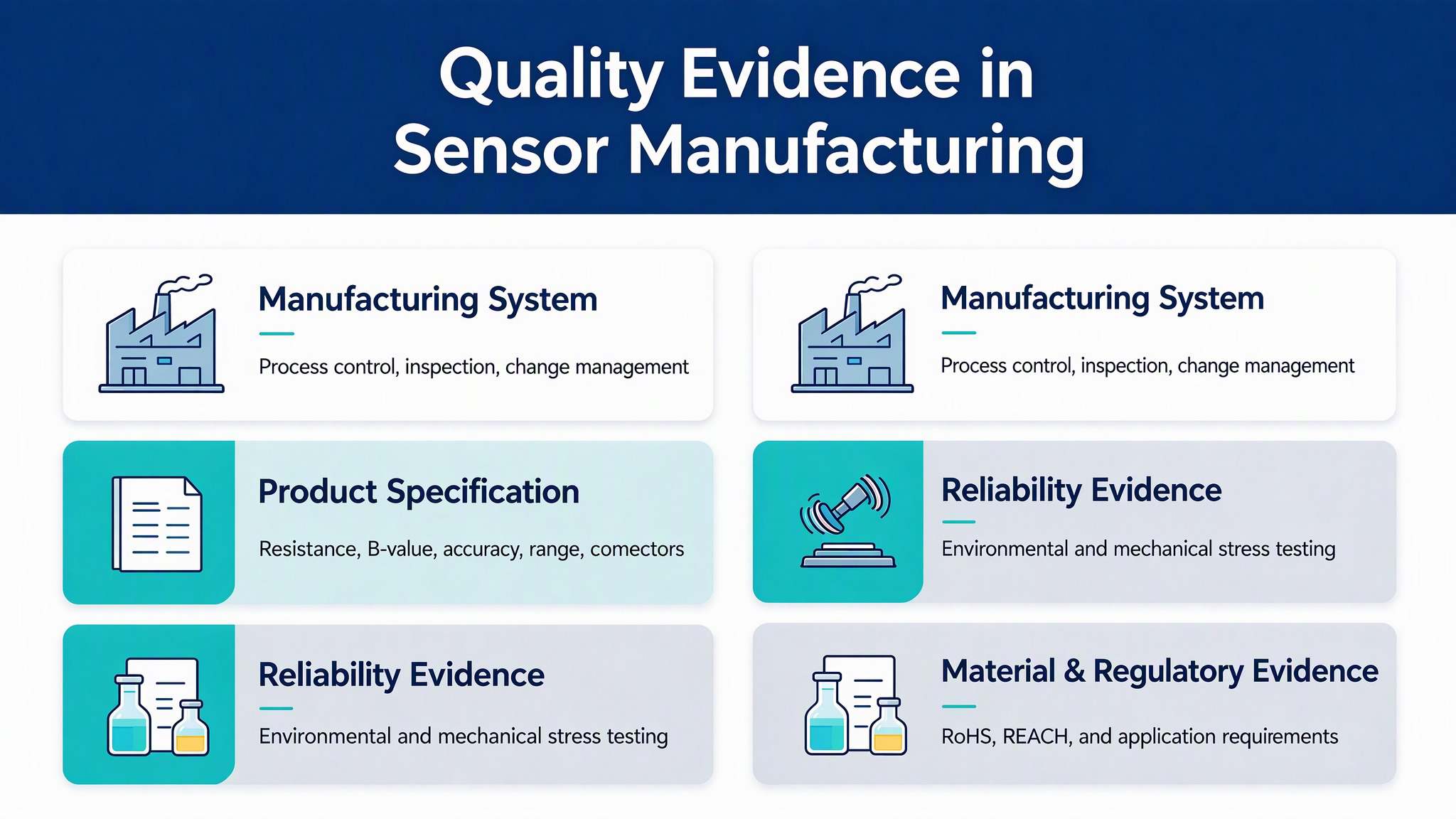
For a sourcing team, quality evidence should therefore connect four levels:
Manufacturing system: Are design, purchasing, production, inspection, change control, and corrective action managed consistently?
Product specification: Are resistance, B-value, accuracy, range, dimensions, connectors, cables, and output requirements defined?
Reliability evidence: Has the relevant component or sensor assembly been evaluated under the environmental and mechanical stresses expected in service?
Material and regulatory evidence: Do the materials and finished assembly support the destination-market and application requirements?
A supplier’s certificate is useful only when its scope and operating controls relate to the product being purchased.
Automotive Sensor Applications: IATF 16949 and AEC-Q200 Are Complementary
Automotive temperature sensors may be used in battery thermal management systems, battery packs, motor and inverter assemblies, engine and coolant systems, transmissions, air-conditioning systems, and electronic control units. These locations can expose components to temperature cycling, humidity, vibration, mechanical shock, soldering stress, and long operating periods.
What IATF 16949 tells a buyer
IATF 16949 is an automotive quality-management-system standard. It builds on ISO 9001 and adds automotive-focused requirements such as risk-based process control, defect prevention, supplier management, product safety, contingency planning, and continual improvement.
For a sensor supplier, an IATF 16949 system can support process discipline across incoming materials, thermistor production, probe assembly, inspection, traceability, nonconforming-product control, and engineering changes. It does not, by itself, prove that every sensor model is qualified for every automotive location.
What AEC-Q200 tells a buyer
AEC-Q200 is associated with stress-test qualification for passive electronic components, including applicable thermistors. It is product- and qualification-specific: the evidence should identify the part, test conditions, limits, and results or qualification status.
Typical stress categories may include high-temperature exposure, temperature cycling, humidity, operational life, mechanical shock, vibration, solderability, board flex, and terminal strength, depending on the component and applicable revision or test plan.
The distinction is important:
IATF 16949: How the automotive supplier manages its quality system and processes.
AEC-Q200: How an applicable passive component is evaluated against defined reliability stresses.
Product validation: Whether the complete sensor assembly, housing, cable, connector, sealing, mounting method, and electrical interface meet the customer’s application requirements.
Do not treat IATF 16949 as an AEC-Q200 product certificate, and do not assume that an AEC-Q200-style test on one component automatically qualifies every customized sensor assembly.
For automotive and EV projects, relevant products may include automotive NTC temperature sensors, battery temperature sensors, and PTC thermistors for motor over-temperature protection. A practical review should cover placement, thermal contact, response time, insulation, vibration, moisture exposure, connector requirements, resistance tolerance, B-value, and the required validation plan.
Industrial Applications: ISO 9001, ISO 14001, and ISO 45001
Industrial temperature sensors operate in automation equipment, pumps, compressors, motors, process machinery, production lines, and control cabinets. The technical priority may be accuracy and stability, or it may be rugged construction, fast response, chemical resistance, or compatibility with a control system.
ISO 9001 supports a quality-management framework for consistent production, inspection, records, corrective action, and continual improvement. For industrial buyers, it is a useful foundation, but it should be reviewed together with product specifications and inspection evidence.
ISO 14001 concerns environmental management. It can be relevant to buyers with environmental requirements in their supplier qualification or sustainability programs.
ISO 45001 concerns occupational health and safety management. It does not certify sensor performance, but it indicates that workplace health and safety is managed within a formal system.
Possible product matches include PT100 and PT1000 RTD temperature sensors for stable measurement, industrial NTC probes for compact temperature detection, temperature transmitters for standardized field signals, and level sensors for tanks or equipment.
When reviewing an industrial sensor, confirm the measurement range, accuracy class or tolerance, wiring configuration, insertion length, sheath material, process connection, IP or sealing requirement where relevant, response time, calibration method, and installation environment.
HVAC and Refrigeration: Match Sensor Design to the Control Point
HVAC and refrigeration systems use sensing to regulate air, water, refrigerant-related equipment, coils, compressors, heat exchangers, storage spaces, and building conditions. A sensor may be mounted on a pipe, attached to a surface, placed in a duct, or integrated into equipment.
For these applications, ISO 9001 is relevant to consistent manufacturing and inspection. RoHS addresses restricted substances in electrical and electronic equipment, while REACH concerns chemical-substance registration, evaluation, authorization, and restriction requirements. RoHS and REACH are not substitutes for accuracy validation or a complete product safety approval.
Selection should start with the control point rather than the sensor name. Check:
temperature range and expected cycling;
resistance value and B-value for an NTC design;
tolerance and calibration requirements;
response time and thermal contact;
moisture, condensation, and waterproofing exposure;
pipe, clamp, surface, duct, or immersion installation;
cable, connector, and controller compatibility;
required signal output for a transmitter.
Relevant solutions may include NTC temperature sensors, pipe clamp sensors, PT1000 sensors, and temperature-and-humidity transmitters.
Medical and Laboratory Applications: Separate Supplier Quality from Device Regulation
Medical equipment, laboratory instruments, analytical systems, and temperature-controlled storage may require high accuracy, repeatability, traceability, cleanable materials, specialized packaging, or documented change control.
ISO 9001 can support manufacturing process control. RoHS and REACH may be relevant to materials and market requirements. However, a sensor supplier’s ISO certificate or FDA-related supporting document should not automatically be described as approval or certification of a finished medical device.
For a medical or laboratory project, the buyer should define:
intended use and measurement location;
accuracy, repeatability, and response-time targets;
calibration and traceability expectations;
patient-contact or sample-contact considerations, if applicable;
cleaning, sterilization, or chemical exposure;
material restrictions and biocompatibility responsibilities;
applicable market and finished-device regulatory pathway;
records required for supplier and product changes.
Precision NTC thermistors, PT100/PT1000 RTD sensors, and laboratory temperature probes may be technically suitable, but the final suitability depends on the complete system, intended use, and documented project requirements.
Home Appliances and Consumer Electronics: Reliability at Scale
Refrigerators, washing machines, water heaters, ovens, coffee machines, and other appliances commonly use temperature sensors for control, protection, and user functions. High-volume programs often require stable electrical characteristics, repeatable assembly, cost control, and compatibility with an established controller.
ISO 9001 can support process consistency. RoHS and REACH documentation can support material-compliance reviews. Additional safety or market requirements may apply depending on the finished appliance and destination country.
Typical design choices include MF58 or MF52 epoxy-coated NTC thermistors for compact temperature sensing, PTC thermistors for motor or over-temperature protection, appliance probes, magnetic door sensors, and level sensors.
The buyer should compare total application cost rather than unit price alone. A lower-cost sensor that needs rework, field replacement, or controller reprogramming may increase total project risk. Confirm the R25 value, B-value, tolerance, response time, encapsulation, wire and connector design, operating range, and sample-to-production consistency.
How to Evaluate a Qualified Sensor Manufacturer
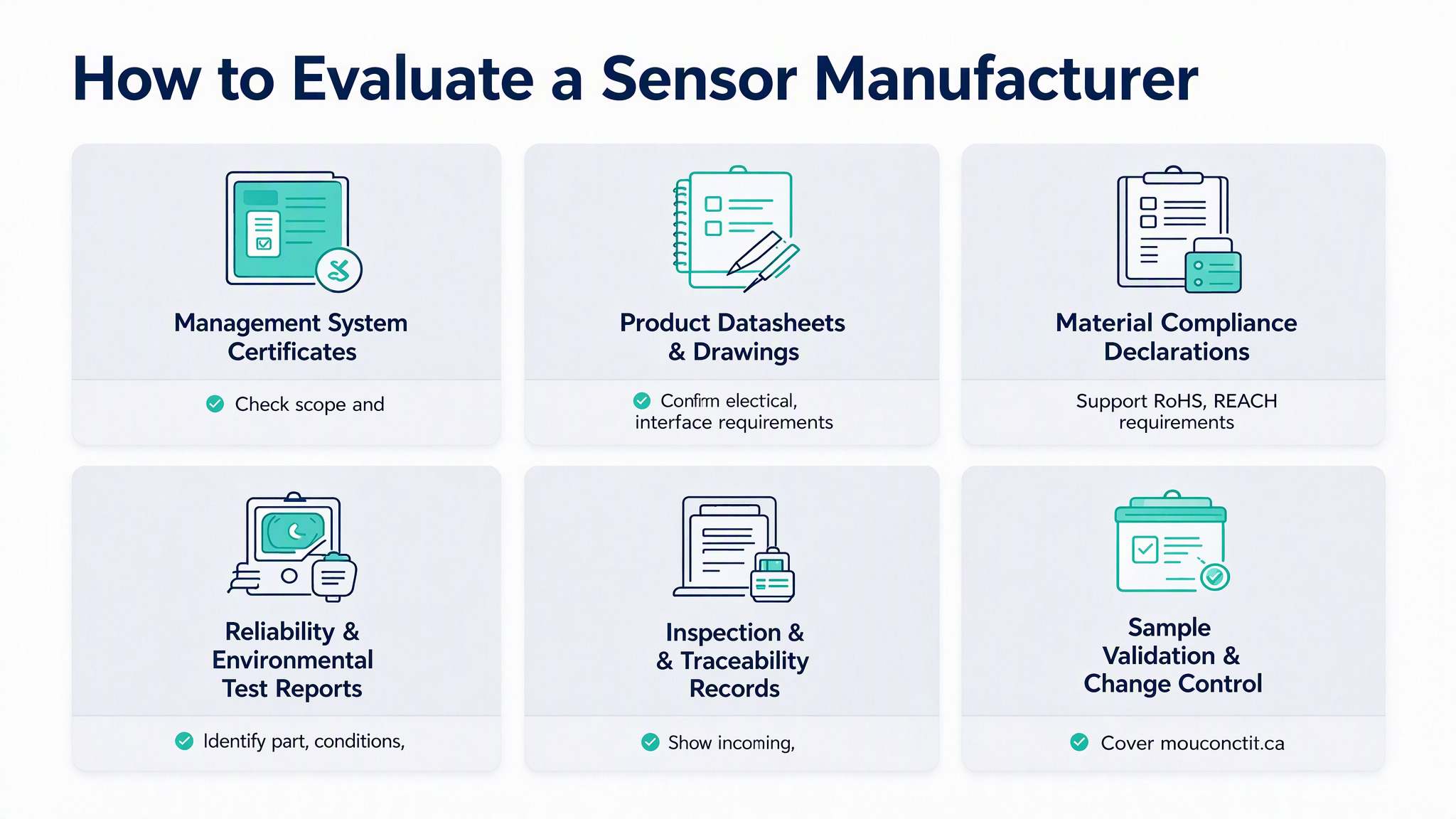
Before approving a supplier, request evidence that maps to your application:
Valid management-system certificates with issuing body, validity, and exact scope.
Product datasheets and drawings covering electrical, mechanical, thermal, and interface requirements.
Material-compliance declarations for applicable RoHS, REACH, and customer-specific substance requirements.
Reliability or environmental test reports identifying the tested part, conditions, duration, acceptance criteria, and results.
Inspection and traceability records showing how incoming materials, processes, and final products are controlled.
Sample-validation plan covering the actual mounting method, cable, connector, potting, overmolding, and controller interface.
Change-control process for materials, tooling, processes, suppliers, and product specifications.
Engineering support for resistance values, B-values, dimensions, sealing, cable materials, connectors, operating range, and installation method.
A qualified supplier should be able to tell you which claims apply to the company’s management system, which apply to a specific product, which are internal capabilities, and which require customer-side validation.
Focusens: Application-Oriented Sensor Manufacturing
Focus Sensing and Control Technology Co., Ltd. provides NTC thermistors, PTC thermistors, PT100/PT1000 RTD temperature sensors, temperature and humidity sensors, liquid level sensors, position sensing solutions, and customized sensor assemblies.
Based on the company information supplied for this article, its quality and compliance framework includes ISO 9001, ISO 14001, ISO 45001, IATF 16949, RoHS and REACH compliance support, and product testing and reliability validation capabilities. For applicable passive components, the company also describes AEC-Q200-based internal testing and reliability evaluation capabilities.
These statements should be read at the correct level. IATF 16949 and the ISO standards refer to management systems. RoHS and REACH refer to material and chemical compliance support. AEC-Q200-based internal evaluation is not the same as a blanket third-party certification for every product. Qualification status and evidence should be confirmed for the specific part and project.
The company’s application-oriented product range can support different design paths: automotive NTC and battery temperature sensors; PTC thermistors for motor protection; PT100/PT1000 probes for industrial and HVAC measurement; temperature and humidity transmitters; level sensors; and customized assemblies with defined resistance, B-value, dimensions, cables, connectors, temperature range, and mounting method.
For a new project, the most useful first step is to share the sensing point, temperature or humidity profile, accuracy target, mechanical constraints, electrical interface, environment, annual demand, and required documentation. The supplier can then evaluate whether a standard component, a probe assembly, or a customized design is the best fit.
Frequently Asked Questions
Does IATF 16949 certify a sensor product?
No. IATF 16949 is a quality-management-system standard for an organization in the automotive supply chain. It does not automatically certify every sensor model or prove that a complete sensor assembly has passed an application-specific validation plan.
What is the difference between IATF 16949 and AEC-Q200?
IATF 16949 addresses the organization’s automotive quality-management processes. AEC-Q200 is associated with stress-test qualification of applicable passive components. They are complementary, not interchangeable.
Are RoHS and REACH product safety certifications?
No. They concern restricted substances and chemical compliance requirements. They do not replace electrical safety approval, accuracy testing, environmental validation, or finished-product regulatory approval.
Can a supplier claim that a sensor is FDA certified?
Only when the exact claim is supported by the applicable documentation and scope. FDA requirements depend on the finished device, intended use, market, and regulatory pathway. A component supplier’s supporting qualification should not be presented as blanket FDA approval of every sensor.
How do I choose between an NTC thermistor and a PT100 RTD?
Compare the controller interface, temperature range, accuracy, stability, response time, size, cost, wiring, self-heating, and environment. NTC thermistors are often attractive for compact and sensitive temperature detection, while RTDs are commonly selected where stable and precise resistance-based measurement is required. The correct choice depends on the complete design.
What should I ask a sensor manufacturer before ordering samples?
Ask for the certificate scope, datasheet, drawings, material declarations, available reliability or environmental test evidence, inspection records, traceability approach, sample-validation plan, and change-control process. Also provide your actual installation and operating conditions so the sample reflects the production design.
Conclusion
Certification terms are useful only when they are connected to the risk of the application.
For automotive and EV systems, review the relationship between IATF 16949 process control, applicable AEC-Q200 component qualification, and complete sensor-assembly validation. For industrial systems, examine QMS discipline, environmental and workplace management, measurement performance, and installation durability. For HVAC and appliances, combine manufacturing consistency with RoHS/REACH evidence and application-specific electrical and mechanical checks. For medical and laboratory projects, define traceability, materials, intended use, and regulatory responsibilities without confusing supplier documents with finished-device approval.
The strongest sourcing decision comes from matching the supplier’s management system, product-level evidence, material documentation, and engineering support to the actual sensing point.
Need a customized sensing solution? Contact Focus Sensing to discuss NTC thermistors, PTC thermistors, PT100/PT1000 RTD sensors, temperature and humidity sensors, liquid level sensors, or a customized sensor assembly for your application.

Expert for Thermistors Temperature Sensors Humidity Sensors Level Sensors ; Reliable but flexible custom products development
100+ Sensing Solutions Developed Annually for Different Applications
80+ Countries Customers Serviced


