




Magnetic door sensors are widely used in modern security systems, smart buildings, industrial equipment, and automated control applications. By detecting changes in the relative position of a magnet and a sensing element, these compact devices provide reliable door status feedback without requiring complex mechanical structures.
As demand for intelligent monitoring and equipment automation continues to grow, magnetic door sensors are becoming increasingly important in applications ranging from residential access control to commercial refrigeration and industrial machinery.
For equipment manufacturers and system integrators, understanding how magnetic door sensors work, where they can be used, and how to select the right configuration is essential for achieving reliable performance and long-term product stability.
1. What Is a Magnetic Door Sensor?
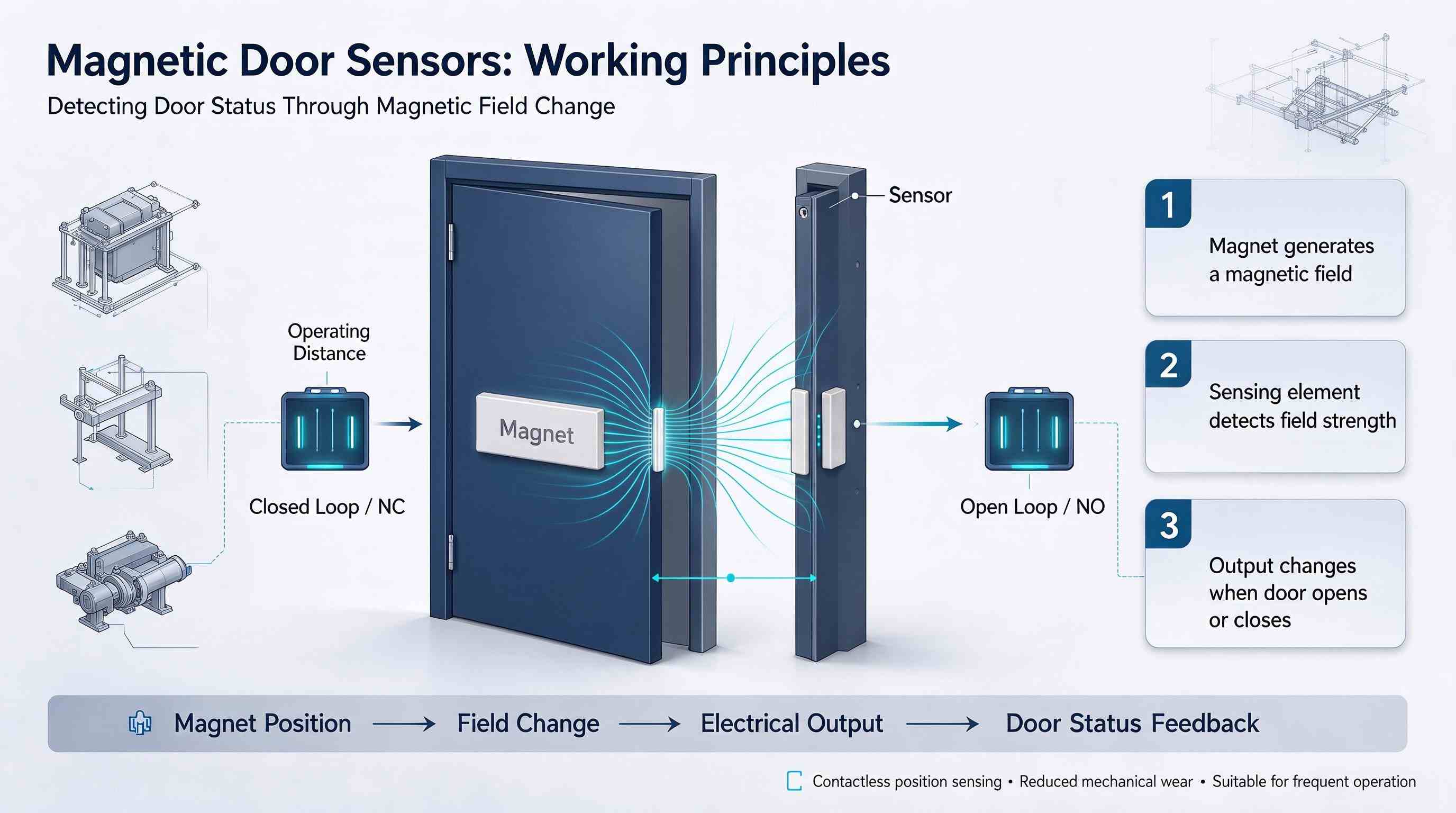
A magnetic door sensor is a position-sensing device designed to detect whether a door, panel, lid, or similar component is open or closed.
A typical magnetic door sensor consists of two main components:
Magnet: Generates a magnetic field and is usually mounted on the moving door or panel.
Sensing element: Detects the magnetic field and changes its electrical output when the magnet moves into or out of the sensing range.
When the door is closed, the magnet and sensing element remain within a specified operating distance. When the door opens, the distance between them changes, causing the sensor output to switch states.
Depending on the design, the sensor may provide a normally open (NO) or normally closed (NC) contact signal, allowing it to connect with an alarm controller, PLC, embedded control board, or other monitoring equipment.
Unlike conventional mechanical limit switches, magnetic door sensors can detect position without direct physical contact between the magnet and the sensing element. This design helps reduce mechanical wear and supports reliable operation in applications involving frequent opening and closing.
2. How Do Magnetic Door Sensors Work?
The operating principle depends on the sensing technology used in the product.
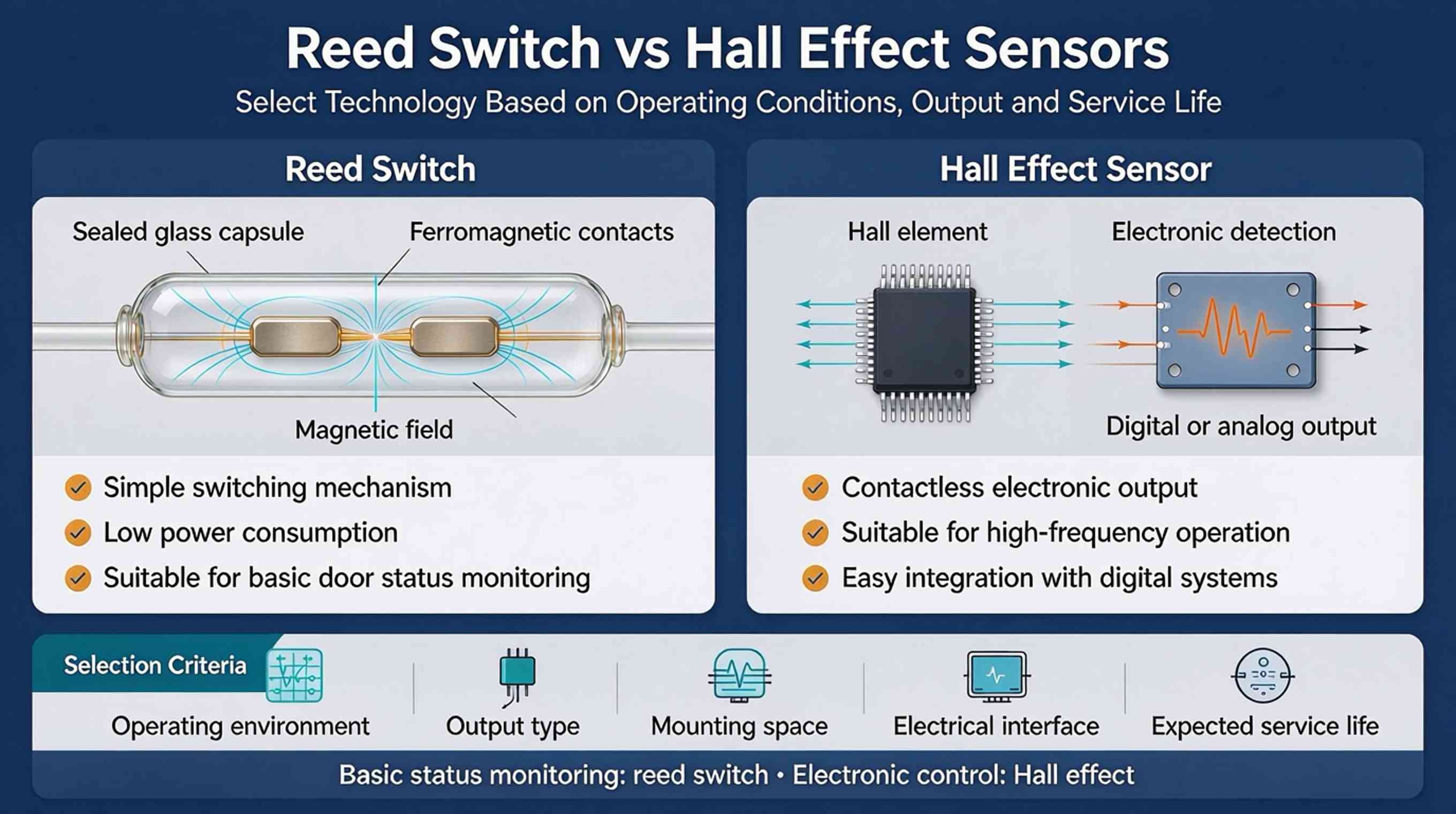
Reed Switch-Based Magnetic Sensors
Reed switch sensors use a pair of ferromagnetic contacts enclosed in a sealed glass capsule. When a suitable magnetic field is applied, the contacts move together and change the electrical circuit state.
Their compact structure, simple switching mechanism, and low power requirements make reed switches suitable for door monitoring, cabinet detection, and various position-sensing applications.
Hall Effect Magnetic Sensors
Hall effect sensors detect magnetic fields electronically rather than relying on mechanical contact movement. They can provide digital switching signals or, in some designs, continuous measurements of magnetic field strength.
Depending on the configuration, Hall effect sensors may be suitable for applications requiring electronic switching, frequent operation, or integration with digital control systems.
Choosing the Right Sensing Technology
The appropriate technology depends on the operating environment, required output, installation space, electrical interface, and target service life.
For example, a basic door status monitoring system may use a reed switch, while an application requiring a semiconductor output or more advanced electronic integration may benefit from a Hall effect solution.
The selection should be based on the actual application requirements rather than assuming that one technology is suitable for every project.
3. Key Applications of Magnetic Door Sensors Across Industries
Magnetic door sensors are no longer limited to conventional security alarms. Their ability to detect position without direct mechanical contact makes them useful across multiple industries.
Smart Home and Building Automation
In smart homes and commercial buildings, magnetic door sensors provide status signals for doors, windows, storage cabinets, and access panels.
Typical applications include:
Detecting unauthorized door or window opening
Triggering lighting when a door opens
Sending door status notifications to a connected monitoring system
Supporting automated ventilation and energy management
Monitoring access to equipment cabinets and restricted areas
For building automation manufacturers, compact sensor dimensions, stable switching performance, and compatibility with the control system are important product considerations.
HVAC and Refrigeration Equipment
Magnetic door sensors can help monitor access panels and door status in heating, ventilation, air conditioning, and refrigeration equipment.
For example, a sensor installed in a commercial refrigerator can provide a door-open signal to the controller. The system may use this signal to activate an alarm, record an event, or initiate a predefined control response.
In HVAC equipment, magnetic sensors can also detect whether a service panel or protective cover is correctly positioned.
When selecting sensors for these applications, engineers should evaluate temperature limits, moisture exposure, mounting structure, switching requirements, and resistance to the expected operating environment.
Industrial Automation and Equipment Monitoring
Industrial machines often contain access doors, maintenance panels, protective covers, and movable enclosures that require position monitoring.
Magnetic door sensors can provide feedback to a PLC or embedded controller, helping equipment operators monitor whether a panel is open or closed.
Potential applications include:
Industrial control cabinets
Automated production equipment
Packaging and processing machinery
Equipment inspection doors
Storage and maintenance enclosures
The sensor output can be incorporated into equipment status monitoring and control logic. However, applications involving personnel protection or safety-rated interlocking require appropriately certified safety devices and system designs. A standard magnetic door sensor should not automatically be treated as a safety-rated switch.
Medical Equipment and Laboratory Instruments
Medical devices and laboratory instruments may contain removable covers, sample compartments, access doors, and enclosed operating areas.
Magnetic sensors can provide position feedback to the control electronics, supporting functions such as access detection, operating status monitoring, and process control.
For these applications, engineers may need to consider compact dimensions, stable electrical characteristics, material compatibility, cleaning requirements, and the equipment's expected service life.
The final sensor configuration should be validated against the relevant device requirements and applicable industry standards.
Automotive and Battery-Related Equipment
Magnetic position sensing can also be used in automotive components and battery-related equipment where the status of a cover, compartment, or movable component needs to be detected.
Depending on the system architecture, magnetic sensors may support access monitoring, enclosure status detection, and electronic control functions.
Automotive applications require careful evaluation of temperature variation, vibration, moisture exposure, electrical characteristics, and long-term reliability. Where applicable, components must also satisfy the qualification and validation requirements specified by the customer.

4. What Factors Should Engineers Consider When Selecting a Magnetic Door Sensor?
Choosing a magnetic door sensor involves more than comparing product dimensions or prices. The sensor must match the mechanical, electrical, and environmental requirements of the application.
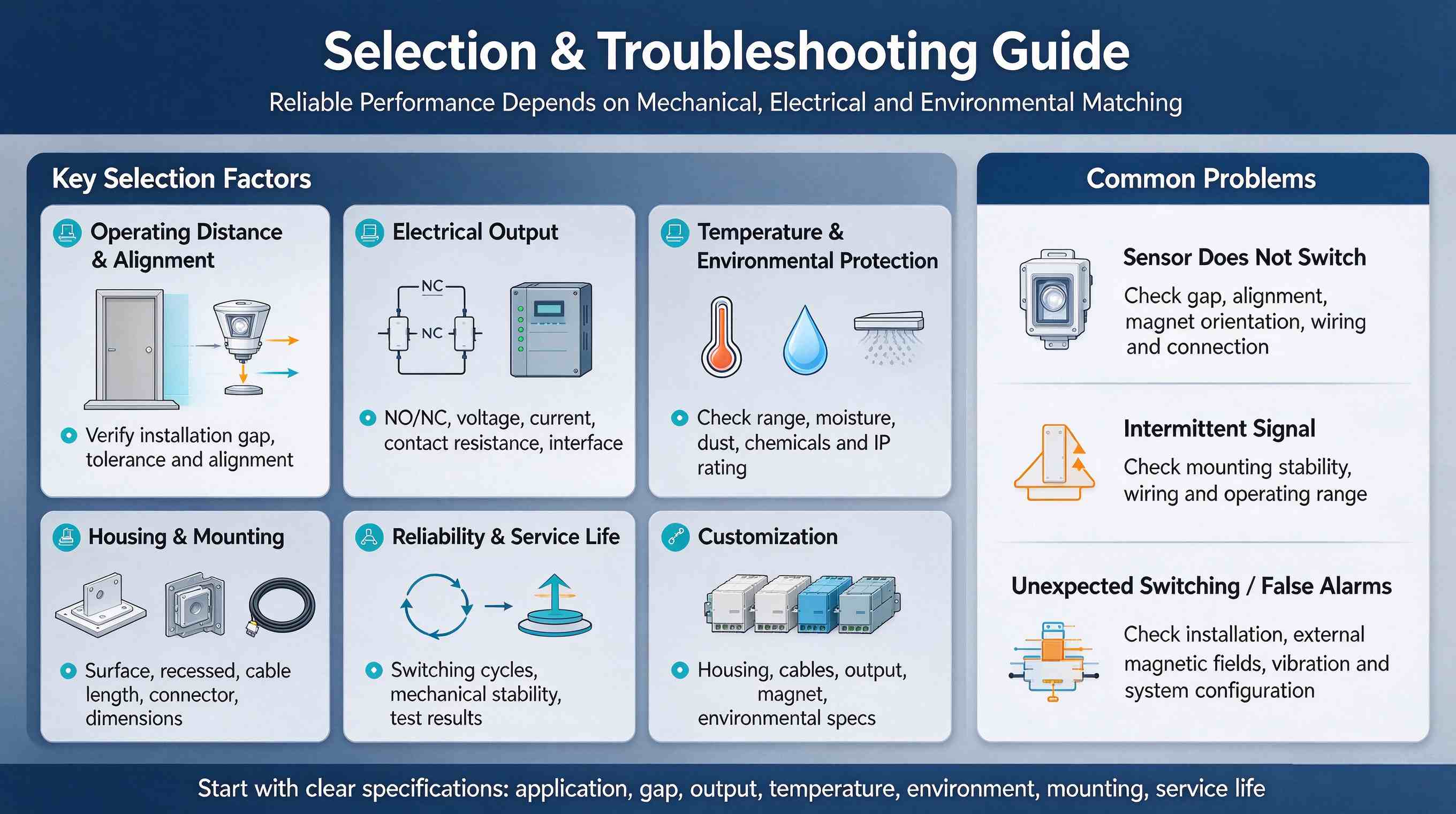
Operating Distance and Alignment
The magnet-to-sensor distance determines whether the device can switch reliably.
Engineers should consider the installation gap, door movement, mounting tolerances, and possible alignment changes during use. The specified operating distance should be verified under actual installation conditions.
Electrical Output and Switching Requirements
Common considerations include:
Normally open (NO) or normally closed (NC) contact configuration
Maximum switching voltage and current
Contact resistance and insulation requirements
Signal compatibility with the controller
Required switching frequency
For electronic sensing solutions, output type and interface compatibility should also be checked.
Operating Temperature and Environmental Protection
The installation environment can significantly affect sensor performance.
Applications involving refrigeration, outdoor enclosures, industrial equipment, or heat-generating machinery may require specific operating temperature ranges and protection against moisture, dust, or chemical exposure.
An IP rating, when specified and tested for the product, helps indicate its level of protection against solid objects and water. The required rating should be selected according to the actual installation conditions.
Housing, Mounting, and Cable Configuration
The physical design of the sensor affects installation efficiency and product integration.
Depending on the application, manufacturers may require surface-mounted or recessed structures, compact housings, different cable lengths, specific connector types, or customized mounting dimensions.
These details are particularly important for OEM equipment manufacturers who need the sensor to fit an existing product design.
Reliability and Service Life
Repeated opening and closing can create substantial operating cycles over the lifetime of a product.
Engineers should review the sensor's rated switching characteristics, mechanical installation stability, environmental compatibility, and relevant test results. Reliability should be evaluated using the actual operating conditions and the manufacturer's specifications.
5. Standard Sensors vs. Customized Magnetic Door Sensor Solutions
Standard magnetic door sensors can be suitable for general-purpose applications. However, equipment manufacturers may encounter integration challenges when their products require specific dimensions, electrical outputs, cable configurations, or environmental performance.
Customized sensor solutions can address these requirements during product development.
| Design consideration | Typical customization options |
|---|---|
| Housing | Different dimensions, shapes, and mounting structures |
| Electrical configuration | NO/NC contact options or application-specific output requirements |
| Cable assembly | Cable length, wire type, connector, and terminal configuration |
| Operating environment | Temperature range and protection requirements |
| Magnetic characteristics | Magnet selection, sensing distance, and installation alignment |
| Integration | Mechanical interfaces and electrical compatibility with the control system |
Customization should begin with a clear technical specification. Important information includes the application, installation drawings, operating temperature, switching requirements, expected service life, and applicable compliance standards.
Prototype evaluation and application testing can then help confirm whether the proposed design meets the equipment manufacturer's requirements.
6. Why Magnetic Door Sensor Design Matters for OEM Manufacturers
For OEM manufacturers, a magnetic door sensor is not simply an off-the-shelf component. It is part of a larger system whose performance depends on mechanical integration, electrical compatibility, and operating conditions.
A sensor that works well in one application may not be suitable for another because of differences in mounting space, temperature, vibration, or control architecture.
Working with an experienced sensor manufacturer can help engineering teams evaluate these variables earlier in the development process.
Key areas of collaboration may include:
Reviewing application requirements and technical drawings
Selecting suitable sensing technologies and configurations
Developing customized housings and cable assemblies
Evaluating prototypes under representative operating conditions
Supporting design adjustments before mass production
A well-defined development process can help reduce integration problems, improve consistency, and support more efficient product launches.
7. Common Magnetic Door Sensor Problems and Troubleshooting
Even a properly designed sensor may experience installation or application-related issues if its operating conditions are not correctly controlled.
Sensor Does Not Switch
Possible causes include excessive magnet-to-sensor distance, incorrect alignment, unsuitable magnet orientation, damaged wiring, or an incompatible electrical connection.
Check the installation gap against the manufacturer's specifications and verify the output using an appropriate test method.
Intermittent Signal
Intermittent switching may result from loose mounting, changing alignment, unstable wiring connections, or operating conditions outside the product's specified range.
Inspect the mechanical installation and electrical connections before replacing the sensor.
Unexpected Switching or False Alarms
Potential causes include incorrect installation, external magnetic fields, unsuitable system configuration, or movement of the door caused by vibration or wind.
Evaluate the sensor's mounting position and magnetic environment. If necessary, consider a different sensing technology or a revised installation design.
Premature Performance Degradation
Environmental exposure, electrical overload, poor cable protection, and mechanical damage may reduce the service life of a sensor.
Using the sensor within its rated electrical and environmental limits, together with appropriate installation and maintenance practices, can help improve long-term performance.
8. Partner with Focus Sensing for Application-Specific Sensor Solutions
Selecting the right sensing component is an important step in developing reliable equipment and automation systems.
Focus Sensing and Control Technology Co., Ltd. provides temperature, humidity, level, and position sensing solutions for a wide range of industrial and commercial applications.
With experience in sensor manufacturing and customized development, Focus Sensing supports OEM and ODM projects that require application-specific product configurations, technical coordination, and engineering support.
For projects involving magnetic door sensors, position detection, or related sensing requirements, engineering teams can evaluate the required sensing technology, mounting dimensions, electrical interface, cable configuration, and environmental conditions before selecting a suitable solution.
Looking for a customized sensor solution for your equipment? Share your application requirements, drawings, or technical specifications with the Focus Sensing team to discuss a suitable configuration for your project.
Frequently Asked Questions
What is the difference between a magnetic door sensor and a mechanical door switch?
A magnetic door sensor detects the relative position of a magnet and a sensing element without requiring direct mechanical contact between them. A mechanical door switch typically relies on physical actuation. The appropriate choice depends on the application, installation conditions, and electrical requirements.
Can magnetic door sensors be used outdoors?
Yes, provided the selected model is designed and rated for the intended outdoor environment. Operating temperature, moisture exposure, dust protection, UV exposure, and mounting conditions should be evaluated before installation.
Are magnetic door sensors suitable for industrial equipment?
They can be suitable for monitoring access doors, covers, cabinets, and movable panels in industrial equipment. However, applications requiring certified personnel protection or safety interlocking need devices specifically designed and approved for those functions.
Can magnetic door sensors be customized?
Depending on the manufacturer's capabilities, customization may include housing dimensions, mounting structures, cable assemblies, electrical configurations, and environmental requirements. The feasibility of each modification should be confirmed against the project's technical specifications.
How do I choose the right magnetic door sensor?
Start by defining the application, installation gap, required output, electrical ratings, operating temperature, environmental exposure, mounting dimensions, and expected service life. These requirements provide a practical basis for comparing standard products or developing a customized solution.
Conclusion
Magnetic door sensors provide a practical way to detect door and panel positions across security systems, smart buildings, HVAC equipment, industrial automation, and other applications.
Understanding the sensing technology, installation requirements, electrical characteristics, and operating environment helps engineers select a solution that fits their equipment design.
For OEM manufacturers and system integrators, customized sensor development can further improve integration and address application-specific requirements.
By evaluating the complete application rather than focusing on the sensor alone, engineering teams can build more reliable monitoring and automation systems.

Expert for Thermistors Temperature Sensors Humidity Sensors Level Sensors ; Reliable but flexible custom products development
100+ Sensing Solutions Developed Annually for Different Applications
80+ Countries Customers Serviced


